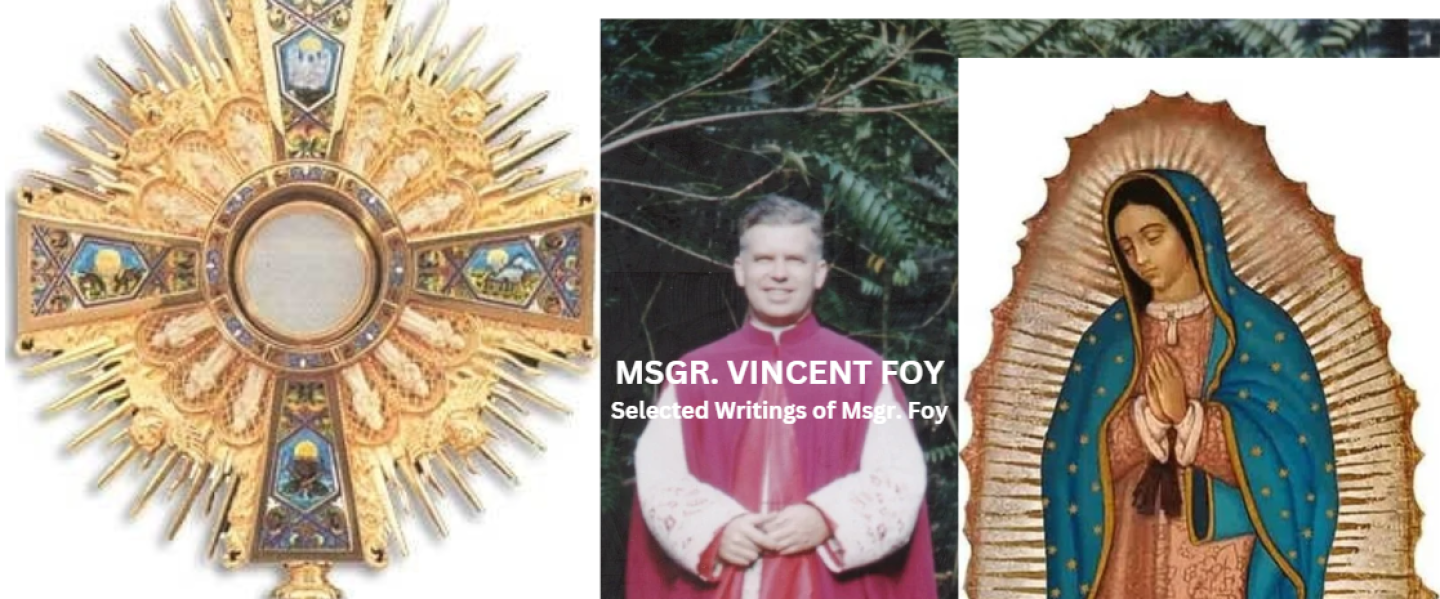
Almost Ordained. By Monsignor Vincent Foy

Almost Ordained

Originally published in Emeritus, Volume 1, Issue 4

By Monsignor Vincent Foy

The summer of 1939 was an exciting one for me, full of hope and joy and new experiences in the priesthood.

Ordained on June 3rd 1939 at the age of 23, with no parish experience as is the fortunate case to-day, every day had its new challenges and surprises. Always in the back of my mind was the promise of Archbishop McGuigan that he would take me to Rome in September, where I was to live at the Canadian College and study Canon Law.

The question of where I was to go for the summer was settled by a ‘phone call’. In those days the newly-ordained priests learned of their appointments not by a formal letter, though that would come later, but by a notice in the morning paper. In mid-June Fr. Fred McGinn (died 1964, aged 60), then curate at Holy Name Parish, phoned me to give me the good news. “Congratulations” he said, “You are going to St. Catherine’s, to be a curate under Dean Cullinane at St. Catherine’s Church. I was a curate at St. Mary’s in St. Catherine’s and can tell you that is a great place to start.”

Soon after I arrived at 3 Lyman St., St. Catherine’s, also known as the Deanery.  The door was opened by Fr. Austin Sweeney ( R.I.P.), now No.1 curate, who graciously received me and showed me to my quarters. It was the room of Father Stan Cassin (died 1947, aged 47) whose belongings were still there. He had developed a stomach ulcer and was on leave for the summer. He was much loved and respected especially for  his work among young people.

So began a quite wonderful three months under Dean Cullinane ( died as Msgr. Cullinane, 1953, aged 68 ). I could literally write a book about that summer. Dean Michael Cullinane, whose brother was the Dean of Tweed, initiated me into the mysteries of pastoral care. He was kindly, good-humored, not above giving a visiting priest an exploding cigar, and a bit of an indirect disciplinarian. Once I had been with Mr. Coyle, a parishonor, to Niagara Falls and got back at 11.05 P.M.. The rectory door was locked and barred. Curates were supposed to be in at 11.00 P.M.. A few coins thrown up against the window of Fr. Sweeny got me re-admitted. I did not let that happen again.

In late July we had a visit from Archbishop McGuigan and his buoyant secretary, Msgr. John Virgil Harris (died 1950, aged 50). The Archbishop reminded me to have my trunk packed and be ready for Rome in September.

In August international affairs took a turn for the worse. Hitler demanded the return of Danzig. Germany signed a non-aggression pact with Russia. England was rapidly re-arming. In St. Catherine’s I noticed that tents were being put up outside the armouries and there was an influx of young soldiers.

Then came the fateful first of September. Hitler’s army invaded Poland. On September 3rd, a Sunday, I was walking down Church St.  in the evening when I heard the cry of a paper-boy:  “ Extra! Extra! England declares war! Athenia sunk!” Only a few hours after England went to war the Athenia, an ocean liner on route from Scotland to Montreal, was sunk by a German submarine.  Many passengers drowned.  Of course my own dream of going to Rome went up in the smoke of battle and I wondered about the future.

The following Saturday a telegram from the Archbishop was delivered at the Deanery. Dean Cullinane was told that I was to report to the Chancery Office on Tuesday, packed and ready to go to the Catholic University of America at Washington. The telegram arrived late at night and I was told about it the next morning. That Sunday I was preaching. The Dean asked me to sit down after the homily and to look surprised when he read the telegram to the congregation. I was to look surprised three times that morning. In the afternoon the Dean told the Sunday-school children that I had volunteered to go to Rome by submarine, but the Archbishop thought it too dangerous.

Tuesday morning I presented myself to the Archbishop at 200 Church St.. I had purchased a new rain-coat because I had been told that there was much rain in Washington. Archbishop McGuigan greeted me warmly and handed me two letters, one a  letter from Msgr. Brennan, the Seminary rector ( died 1978, aged 87 ), detailing my seminary record and the other a letter of introduction to Dr. Motry, Dean of the Faculty of Canon Law. I was directed to see Fr Callaghan, the Chancellor,( died 1960, aged 64 ), who would get the information about my accommodations.

While I was in his office Fr. Callaghan ‘phoned Dr. Motry. Dr. Motry said yes, he was expecting Fr. Foy and that lectures had already started. When asked about accommodations he said: “ I have nothing to do with that. That is in the hands of Dr. Armand at the Priests’ Residence.” Next came a call to Dr. Armand. I could see a look of surprise on Fr. Callaghan’s face. Dr. Armand informed him that because of the war their house was packed, with not a room left. I suggested that perhaps I could stay at one of the Religious Houses. The reply was ( I never understood why ), “If you can’t stay with the other diocesan priests, you are not going.”

I returned to the Archbishop’s Office and told him the news. He commiserated with me, but then his face lit up. “Ah! Now I remember! Only last week I received a letter from Fr. Aderville Bureau ( died 1949 in the crash of the Canadian Pilgrim plane over the Alps ). He is the dean of the new Canon Law Faculty at Laval started because of the war. They are anxious for more student priests.” A phone call settled everything. That night I was on the train to Quebec. It was like going to another world. Previously I had never traveled further than Buffalo.

Here I would like to add that another class-mate was sent away for post-graduate studies:  Fr. Matt Darby (died 1970, aged 56 ). He knew early in September that he was going to Laval to study theology, and envied me when I phoned to tell him I was going to Washington. He did not relish taking courses in Latin. In the seminary his highest marks were in Canon Law and mine were in Dogmatic Theology. Did the Archbishop get our marks confused? We never knew.

Fr. Darby arrived in Quebec City the day after I did, on a Thursday. I was already in my quarters at the

“Maison des Etudiants”  on Rue St. Joachim, an old and dilapidated residence for student priests, where rats roamed at liberty.The “Maison” was about a 20 minutes walk from the university. I had already reported to the Chancery Office as required, to obtain the “ Faculties” of the Archdiocese, and was given a copy of the Archdiocesan regulations.  I was down at the railway station to greet Fr. Matt as he stepped off the train. “Bienvenue a Quebec”, I said, and I could see that he was not altogether happy about his new life. “Do I have to wear that ?” he asked, as he looked at my soutane. “Yes” I said, “and there are a few more rules I will tell you about. The good news is that because we are from outside of the province, we don’t have to wear the tonsure.” The tonsure was a round bald spot on the top of the head which then cost Quebec priests ten cents when they got their hair cut. So began our great adventure in dear old Quebec.

Curator of the Museum. By Monsignor Vincent Foy

Curator of the Museum

By Monsignor Vincent Foy

It was September 1934. We who had entered St. Augustine’s Seminary in 1933 had the joy and privilege of going into our second year of Philosophy. Our text was in Latin by Lortie, professor of Philosophy at Laval in Quebec City. Years later I was to discover his grave in the crypt of the old chapel at the entrance to the Quebec seminary.

Out of twenty-one students in first year Philosophy for Toronto Archdiocese, twenty returned in 1934. Missing was Joe Cartan, whose blood uncle was my uncle by marriage. He was married in 1938 on the same day most of the rest of us became Deacons. He would go on to become General Manager of Massey Hall. Jack Myers came into the seminary from St. Michael’s College in September 1934, so we were still twenty-one for Toronto.

We in second year Philosophy went as it were from the bottom to the top. The seminary was so full in 1932-33, with some students doubling up, that in the summer of 1933 rooms were hastily built in the basement of the main building. We referred to them as “the Catacombs”. Now we found ourselves at the top of the annex called “Kehoe Hall” after our beloved Spiritual Director Fr. Kehoe. My room in Kehoe Hall was number 159 on the top or fourth floor.

On the bulletin board upon our return were the names of seminarians appointed to special tasks, e.g. Head Prefect, the other Prefects, sacristans, master of ceremonies etc. I was named to the lofty position of Curator of the Museum.

The museum, long since gone, was at the south end of the main corridor on the ground floor. It contained numerous glass cases with interesting items from many countries, mostly from the Holy Land. The museum was also the Reading Room. There we were allowed to read Catholic newspapers and periodicals in our free time on Thursdays or Sundays. We were not allowed to receive secular newspapers or have a radio in our rooms. Until Archbishop McGuigan came in 1935 the front and sporting pages of the Toronto Globe and The Mail and Empire were posted on the bulletin board after lunch, in the corridor leading to the Annex. That was stopped when Archbishop McGuigan first came to talk to us in the chapel. He told us we were “the apple of his eye”. He also said that anyone found with a newspaper in his room would be “peremptorily expelled”.

My position as Curator of the Museum was not all honour and glory. I was to dust it and clean it and keep it in good general shape during my recreation time. I also had to knock on the President’s door every Thursday and Sunday mornings to get an armful of Catholic reading to be temporarily put in the Reading Room, and return them later. This was to me a rather fearful experience. The President, Msgr. Francis P. Carroll, later Bishop of Calgary, was not always pleased with my intrusions. Sometimes he would say “Can’t you see I’m busy. Come back later.” Or in a voice from his inner room would shout out “Later! Later!” Once I was put out three times and did not go back. After lunch I was given a rather severe reprimand for not doing so.

All went well until the spring of 1935. It was announced that we were to have an Apostolic Visitation by the Apostolic Delegate, Archbishop Cassulo. I was called in and told that the museum had to be in better shape. Among other things I was told that every label, and there were many, had to be replaced. They were getting yellow with age. I was given the rare privilege of staying inside the building during the main recreation period of 4:00 to 5:30pm to carry out renovations.

Let me digress. Another interesting preparation was for the possible entrance of the Delegate during one of our lectures. Although most texts were in Latin, the lectures were in English. Our professors were simply unable to speak Latin like those in Montreal and Quebec City. So Father Ingolsby, who taught philosophy, practiced one lecture in Latin and we were given a few Latin questions to ask. Thankfully the classroom visit did not come, at least to us.

Archbishop Cassulo, later Delegate to Hungary where he was once stoned by communists, did make a thorough investigation of all the seminary facilities. He visited many student rooms and later reported a number of repairs to be made.

The rule that one could not stay in one’s room during the main recreation period was a strict one! We were supposed to be out playing handball or other sports or climbing the Scarboro Bluffs on the property or walking in pairs or groups. Walking alone was prohibited, as I found out during my first week in the seminary.

It happened that after my diligent work in the museum I was quite exhausted. For the first and last time in my six years in the seminary, I took to my bed during the main recreation period. I thought I was safe on the fourth or top floor of Kehoe Hall.

Happily in bed, at about 4:30 pm I heard footsteps on the stairs and then voices. One of them was the very recognizable voice of Msgr. Carroll. The other heavily accented voice I knew must be that of the Delegate. I was quite terrified. My room was just opposite the top of the stairs. I heard them go into the room next to mine on one side, and then go into the room next to mine on the other side. When I heard them going down the stairs I said a silent prayer of thanksgiving.

If Msgr. Carroll had opened the door of room 159 and found me cowering under the sheets, I wonder whether I would be writing this today?

Personal Memories of Msgr. Vincent Foy: Apples and Applesauce, Dining at St. Augustine’s Seminary in the nineteen thirties

By Msgr. Vincent Foy

Apples and Applesauce

Dining at St. Augustine’s Seminary in the nineteen thirties

Ordinarily, during recreation periods at St. Augustine’s Seminary, we were not permitted to walk alone. That rule did not apply during retreats, when silence was to be observed. I remember that on retreat in September of 1934 I was walking in the apple orchard, which took up the large patch of land from the entrance-gate to the seminary on the eastside. By a remarkable coincidence, I was just reaching up to pick an apple when there was a tap on my shoulder. I looked around to see Fr. Martin Johnson, our bursar (later Bishop Johnson of Nelson, B.C., and still later Archbishop of Vancouver). “Mr. Foy”, he said, “You are not allowed to pick the apples in the orchard. You will get your apples in the form of applesauce in the refectory”. Indeed, our dessert was often applesauce from that bountiful orchard.

Dining at St. Augustine’s in the nineteen thirties was somewhat different from dining there today. Seminarians sat at approximately twenty oblong tables, ten students at each table. There was a Prefect, a Deacon, at each table. There was also a special table for Deacons who were not table Prefects. They sat at Table No.1, directly beneath the raised platform at the south end of the refectory where the professors sat at the head table.The rector sat at the center of this table, facing the students. He had charge of the dinner bell, signaling when talking could begin or when to stand for concluding grace.

The students of each table took turns in waiting on the others. Two were assigned to the head table. Each of the others was assigned to two or three tables. It was by drawing lots that the head table waiters were chosen. This was not an envied duty. I remember that in my first year Clem Dougherty drew the head table. He begged me to take his place, which I did, and remained a head table waiter for most of my seminary days. On his first experience at the head table, Leo Murray was so nervous that he spilled the soup on the lap of the rector, then Msgr. Francis Carroll, later bishop of Calgary. “Get down out of here” said the rector “and never come back”. Leo was happy to comply.

Waiters never saw the St. Martha Sisters and their help in the kitchen. Staples like the soup tureen and bread and butter and milk were on the table when we entered the refectory. The main dishes were served on a revolving drum from which the waiters took the plates to their hungry companions. After meals the waiters had their fill, and I mean fill, because they had free access to whatever was left over at the head table. The pickings there were good indeed-meat and vegetables and pies. Al Goetz, once a butcher’s assistant, had an astonishing appetite for meat and eggs. I recall that after one waiting duty he finished off eight or nine eggs from a head table platter.

Meals were good, but appetites were even better. When I went to the seminary in 1933, we had bacon and eggs every Sunday morning. I was told that before our time bacon and eggs were served every morning. In the thirties that privilege was reserved to the head table. One or two professors even had a breakfast steak. Two or three times a week we were served two pies per table. I had the distinguished honor of being pie-cutter at my end of the table. The secret of retaining that position was to cut oneself a portion slightly smaller than the others. It was then easy to cut the remainder into four equal parts. During Lent some of us gave up pie and the extra pieces were graciously devoured by Lenten pie-eaters.

Seminary pies bring to mind our best checker player, a seminarian from Winnipeg known as the “The Sheriff”. At St.Augustine’s we could not stay indoors during the evening recreation hour. Seminarians at the China Mission Seminary were allowed that privilege and sometimes we joined them. The Sheriff habitually sat at a table with a checker board and challenged all comers. If he did not win five games in a row, he would send you his next piece of pie. If you lost five games in a row you would send him your next pie slice. I challenged him once and lost my next pie. It was a rare occasion when he did not have two or three portions of pie on pie days.

Our food was wholesome. Bread was baked by the Sisters, and there was an unlimited supply. Many vegetables came from the seminary farm. Milk was from our own dairy herd. It was not pasteurized, though the herd was regularly inspected. About 1936 Jim Meehan of Ogdensburg and Fr. Leonard Hodgins, our bursar, came down with undulant fever from the milk, and were seriously ill. That was the end of our nonpasteurized milk. It was the recurring fever which was the principal cause of Fr. Hodgins’s death in January, 1943, at the age of 44.

Alcohol was a no-no. On the Easter Monday free day about 1936, two seminarians returned from downtown Toronto with alcohol on their breath and were immediately expelled. The penalty for drinking an alcoholic beverage during vacation was dismissal. All Toronto students, before becoming Deacons, were required to take a solemn pledge, in the chapel with hand on the bible, to abstain from alcoholic beverages for a period of ten years.

Shortly after he arrived in Toronto, Archbishop McGuigan, concerned about the large Archdiocesan debt, employed an efficiency expert, a Mr. Stoeckle, to cut down seminary expenses. Gone went the Sunday morning bacon and eggs, up went the frequency of applesauce desserts. Whereas formerly pancakes and syrup were served occasionally as dessert, now they became a main course. Once tripe was served for dinner, but so widespread was its rejection that the rector promised it would never be served again.

It was a rule that no food was to be kept in one’s room. Like all rules without serious consequences it was often honored in the breach. In the Fall of 1933, Dr. Davis (later Msgr.), the Prefect of Discipline, announced there would be an official visitation of all rooms. When the knock came on the door (incidentally, no locks were allowed on doors) we were to open our trunk or any other containers and stand at attention outside the door until the inspection was complete. One autumn evening the knock came on my door–room H in the basement of the main building. After the examination Dr.Davis reported that all was in order except some fluff under the bed, which I was to take care of immediately. I do not recall that any seminarian was found with contraband in his room.

A few weeks later, Dr. Davis replaced the rector at 5.30 p.m. in the spiritual lecture room. He informed us that though he informed us beforehand of his visitation while we were in our rooms, we were not told of a subsequent visitation when we were not in our rooms. He said that some had broken an important disciplinary rule and were to be admonished. He read a list of about twelve seminarians: “Mr. Albert De Luca, you had cheese and crackers in your desk drawer. Mr. Matthew Darby, you had an apple in your bookcase. Mr.Percy Johnson, you had a Sweet Marie chocolate bar under some papers. Mr.Bernard Belanger, you had two packages of Planters’ Peanuts in plain view”. etc.

The public admonition did not entirely correct this abuse. Sometimes concerned parents smuggled in edibles on the two Sunday afternoon visiting periods allowed per month. I recall one occasion when Art McMahon had been brought a large paper bag full of apples. As he was rushing from the outer to the inner door, the bag broke and apples went rolling over the floor in full view of the visitors. There was much laughter as Art gathered up his forbidden fruit and disappeared in great haste. It must be said that in my time, to my knowledge, no one broke the rule against having a magazine or newspaper in one’s room. That would have resulted in expulsion.

There was another breach of the rule for which many should have later struck their breasts and said “mea culpa”. On Thursday afternoons we were allowed to trek as far as we could go along the shore or even along the top of the bluffs to the East. Then there were nothing but open fields until one came to the Guild of all Arts buildings. Occasionally in good weather some seminarians participated in a grand wiener roast on the fields not far to the East. By some mysterious communication a truck delivering wieners and buns was met on the road leading down from the China Mission Seminary. By another mysterious connection with the Sisters of St. Martha, a good supply of butter was obtained. All of this resulted in a grand picnic over a good fire. I have photographic evidence of this delinquent behavior. There is Ross Guernsey, Frank Flynn, Al DeLuca, Matt Darby, Gerry Loftus, Bill O’Flaherty, myself and others in festive mood.

On the one occasion, when I could not make it to the picnic, the revelers were discovered by a hiking professor. This was reported to Dr. Davis and there was a public reprimand. Each hot-dog consumer was named in the spiritual lecture hall and required to pay an individual visit to Dr.Davis in his study. So our picnics came to an inglorious end.

In the Fall of 1934 it was discovered that a few seminarians were in the habit of visiting Wade’s Dance Hall, on top of the bluffs just to the West of our property. There on Thursday afternoons one could relax over a cup of coffee or coke and biscuits. There was even a five-cent slot machine. It was rumored that a certain student, who shall be unnamed, lost $5.00 on that greedy machine. This was during the depression when most of us had no more than a dollar or two to our names. Word got around, and Wade’s was declared off limits.

All in all, we dined well at St.Augustine’s in the nineteen thirties. It was not exactly like dining at the Ritz but the curbs on our voracious appetites was a lesson in temperance. There was little danger of obesity. It was a bit of a mystery how Louie, “butter-ball” Hickey maintained his avoirdupois. Surely, among our happiest seminary memories were the times at table, enjoying not only the meals, but especially the good company, high spirits and cheerful banter of our companions.