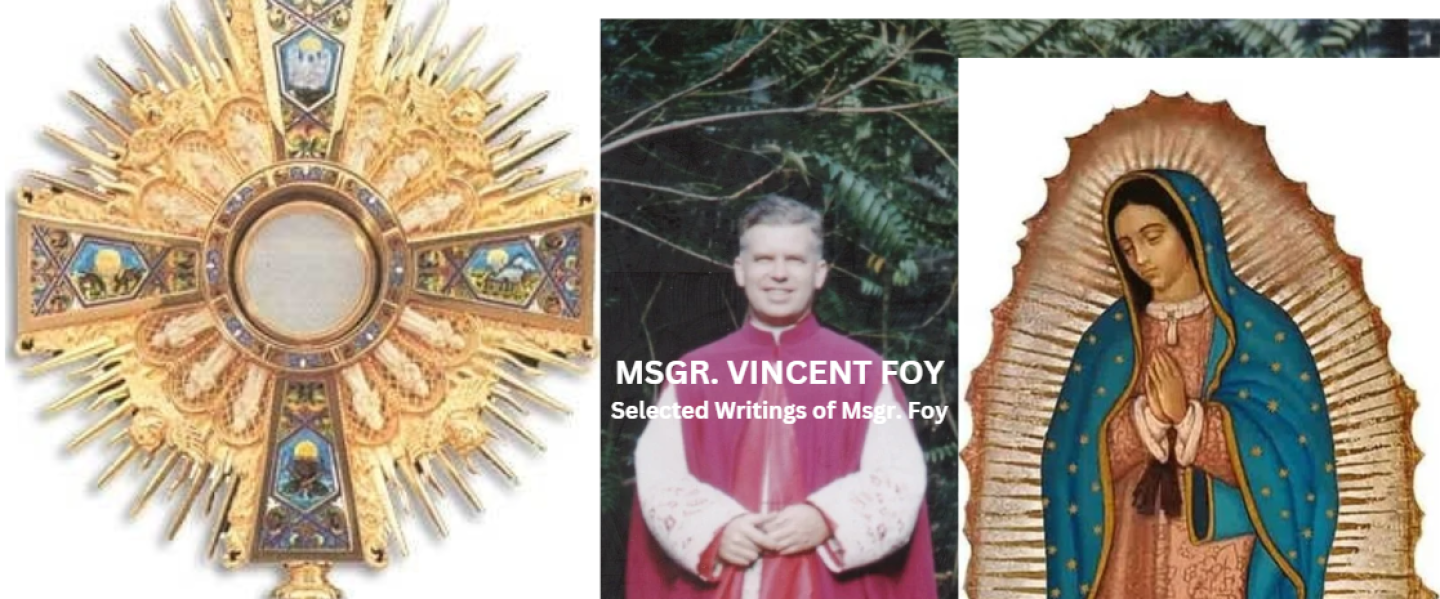
Personal Memories: “Dr. Markle’s Call-Wheel”. By Monsignor Vincent Foy

The following article was originally published in Emeritus. 

Dr. Markle’s Call-Wheel

By Monsignor Vincent Foy

As star differs from star, so does teacher differ from teacher. That was the way it  was with our professors at St. Augustine’s Seminary in the nineteen-thirties. There were bright star teachers and less bright star teachers. One thing they had in common: all were dedicated priests doing their best to mold the rough clay of seminarians into fit vessels for the priesthood.

The rector until late 1935, when he was named bishop of Calgary, was Father, later Msgr., Francis P. Carroll. He taught Sacred Scripture, but our class did not have the privilege of listening to his lectures. I imagine he was an excellent teacher. Who can forget those piercing eyes and intensity of delivery as he gave us our half-hour spiritual  lectures five days a week? Every lecture was written by hand, but reading them did not prevent eye contact. One felt that he was talking to each of us personally. In his presentation the Seminary Rule took on the gravity of the Ten Commandments. A great priest and rector!

Our Spiritual Director and professor of Ascetic Theology was Dr. Cyril Kehoe, a Carmelite Father who had been at St. Augustine’s from its opening. He was well past his prime, but we had great respect for him. We called him “The Chief”. He taught well with  a question and answer method. So trusting was he that when we had our term exams he presented us with the questions and then announced: “Gentlemen, I know that I can trust you completely”. He would then retire to his room and return shortly before the end of the test time. I am ashamed to report that in his absence two or three students pulled out their notebooks to refresh their memories-proof of original sin even in those hallowed halls.

Fr.Richard “Dickie” Dobell taught us English Literature and Rhetoric in our philosophy years and Sacred Scripture in our theology years.He was methodical and dedicated and in my opinion a good teacher. His notes were those used by Fr. Carroll and for the most part  handed down from the noted Scripture scholar Msgr. Kissane who taught at St. Augustine’s  in its early years and later was rector of Maynooth in Ireland. Fr. Dobell was not charismatic and I do not recall that he ever told us a joke. Once he asked for a quote from Scripture illustrating God’s Providence. Howard MacMillan raised his hand. “Yes, Mr. MacMillan?”. Howard answered: “Dr., ‘The hairs of your head are numbered’ .”. There was loud laughter, for Fr. Dobell, then in his thirties, was quite bald. His face blushed crimson  as he replied : “Mr. MacMillan, one day you may come to this same sorry state.”

Fr. John “Buck Ingoldsby taught us Latin and Philosophy from the Latin text by Lortie. We respected him greatly for his dedication and sincerity. He taught by the book; even jokes he told every year were written in the margin of his text. One of his favorite expressions was: “Gentlemen, I say to you now what I have said before: learn to profit from your mistakes.”

Dr. Lucius Barnett was our teacher of Canon Law. His course in Canon Law was really a post-graduate course. He rarely came into class without an armful of books and was able to give an assortment of opinions on any given point, so that often we were confused by the abundance of contradictory pronouncements. I confess to often nodding during his classes. Once I kept awake by counting the frequency of his use of the word “then”. I tallied 133 “thens” in one lecture. Dr. Barnett’s zeal and expertise made him an invaluable resource for pastors, the chancellor and the marriage tribunal.

Church history was taught by Dr. J.B. O’Reilly, (“J. B.”). I confess that I enjoyed his lectures more than any others. Although our text was the great four-volume “History of the Church” by Philip Hughes, “J. B.” found it impossible to stay with any text or program. His talks were wide-ranging, the fruit of his voracious reading. Books were piled high in his one-room quarters, giving him a narrow passageway to the sink and his bed.

Head and shoulders over all our professors as a teacher was Dr. William Davis. He taught moral theology, with three volumes of Noldin, in Latin, as our text. Dr. Davis was not a scholar, but imparted expertly what he knew, with clarity, emphasis and enthusiasm. Who will ever forget the principles of double effect when they were taught by Dr. “Bill” Davis? Hardly any extra study was needed in moral theology, so well were we taught. All who came under his tutelage were especially grateful to Dr. Davis.

Other stars in the professorial galaxy were Fr. Basil Ellard, Fr. Alphonse Belanger and Fr. Gerald Quinlan. They are remembered with gratitude..

All the above is prologue. The teacher who influenced my studies above all others was Dr. Louis, “Louie” Markle, our professor of Dogmatic Theology. He was ordained in 1921. When he taught our class from 1936 to 1939 he was in his early forties, though to us he seemed older. In the second and third year of our theology course he taught us from the Latin text of Herve. In fourth year theology, the text was the Latin “Summa” of St.Thomas Aquinas.

Dr. Markle had the reputation of being an excellent spiritual director, but he was a poor teacher. His method centred around a call-wheel. This instrument of torture was a small aluminum wheel mounted on a metal base. It was marked along the circumference with as many numbers as there were students- about seventy, for second and third theology students took their dogma together. Each of us had a number, recorded in a notebook on Dr. Markle’s desk. At the beginning of the class the call-wheel was given a whirl and when it stopped a little arrow indicated the fateful number. The name of the unlucky seminarian corresponding to the number was called and then began a perhaps twenty or thirty minute grilling on the matter assigned the previous day. Sometimes there was only one call, sometime two.

In the normal course of events, one could expect two or three calls in a term. So intelligent was the wheel that some seminarians were never called, or very rarely. Albert Goetz, who repaired the professors’ watches, and had been out of school for a few years, and had now reached the advanced age of about thirty, was never called. Towards the end of the class we were assigned a section of Herve for study, with very little explanation. Because Dr. Markle believed that dogmatic theology was more important than any other subject, he insisted that we should spend an hour and a half of study each day on his assignment. Our longest study period was from 7.30 p.m. to 9.15 p.m.., when we went to chapel for the rosary and night prayers. Lights were out at 9.45. So, according to Dr. Markle, the study of all other subjects was to take place in the brief study periods before or after each lecture. This seemed unreasonable to me.

Early in the Fall of 1936 , I made an analysis of Dr. Markle’s calls and found that by making a point by point summary I could “get up” a call in about half an hour. Using this method I survived my first call quite well and so continued in blissful ignorance of what was to come.

One evening I was out walking with my good friend and classmate Leo Austin. We had been friends and classmates all through De La Salle High School from 1928 to 1933. At the seminary I had chosen the newly-ordained (1933) Fr. Alphonse Belanger as my Spiritual Director; Leo had chosen Dr. Markle. I explained to Leo my method of preparing for the inevitable calls in Dogma and how it could be done in half an hour. In all innocence, when he next went for weekly Confession and spiritual direction, he mentioned how Foy could get up a call in half an hour.

The following Monday morning, greeting us with his usual good-natured smile, Dr. Markle spun the call-wheel, but before it had stopped he called out “Number 12-Mr. Foy!”. I had no idea of the inquisition to follow. He questioned me on points not in the text and in the foot-notes and in general made me look like a perfect ignoramus. At the end of a long call he asked “Mr. Foy, how much time did you spend on this assignment?” I truthfully replied “Half an hour, Dr.”. He said “How much time did I say you should spend?”. “An hour and a half, Dr.”. He replied with a frown, “Now you see the reason”. I had no idea at this point that Leo Austin had told him of my brilliant method.

Thinking that I was safe from a call for two or three weeks at least, I went back to my method. That was a big mistake. The next day, again before the wheel had stopped , Dr. Markle called out my number and name. This time the inquisition was even more detailed and the humiliation more complete. Again I was asked how much time I had spent on the call and again I replied honestly “Half an hour”, and I was rebuked more severely. A third day I was “put to the blush”. This time I said truthfully I had spent an hour on the subject and was told “Evidently that is not enough”.

I realized I was in deep trouble. My worst fears were confirmed. I learned that Leo Austin had innocently betrayed me. It was also obvious that Dr. Markle thought I had told many in the class of my technique and that his authority had been undermined. Actually, I had told only Leo.

From then on, until ordination, I spent an hour and a half in preparation for each class of Dogmatic Theology. In the Fall of 1936 I had at least 15 calls. Until May of 1939 I had many more than my share of calls. The result was that I had the highest marks in Dogma, and it became my favorite subject.

My good friend and class-mate Matt Darby had a favorite subject: Canon Law. That was my worst. He was always apprehensive about making a poor showing during the Dogma calls. After ordination we were both sent to Laval University in Quebec City for post-graduate studies: he to study Theology and I to study Canon Law. We never knew whether Archbishop McGuigan had made a mistake or whether he over-ruled the recommendation of the Seminary. We never asked.

That is the story of Dr. Markle’s call-wheel. It was a smart wheel. A few it ignored. Some it remembered only occasionally. Some it treated kindly. For those suspected of not recognizing Dogma as the Queen of all Ecclesiastical Studies, it could be a little severe. For some time after seminary days, in my dreams I could see a little spinning wheel and then a mellifluous voice call out: “No.12!.  Mr. Foy!!”

Personal Memories of Msgr. Vincent Foy: A Vocation Almost Lost

The following article was originally published in Emeritus, Volume 1, Issue 6.

A Vocation Almost Lost

By Monsignor Vincent Foy

Every priest walks a unique path to the altar. Some vocations come late, others early. Here I briefly recount my own providential journey, for which I am eternally grateful.

My hope of becoming a priest began when I was eight years old, in December of 1923. It was on December 22nd of that year, in St. Michael’s Hospital, that my mother gave birth to my sister Doreen, now a retired nurse. Soon after my mother, then 38 years old, grew gravely ill with double pneumonia, and was not expected to live. There were no antibiotics in those days.

As though it were yesterday, I recall our father gathering together my older brother Edward, my younger brother Jack and me, in our parlor. The doctor had told him that it would be most unlikely that mother would last the night and that the children should be prepared. Our father told us that mother was very sick and God might be calling her to heaven and we should be brave.

Shortly afterwards I went into the dining-room, separated from the parlor by sliding doors, and paced up and down, tears streaming down my face. I promised God that if mother lived I would do my best to become a priest. That is not the best way to choose a vocation, but that is the way it was with me.

Remarkably, my mother passed the crisis and next day was considerably better. From that day I never wavered in my hope and resolve. I never told my mother or anyone of my promise. Incidentally, while mother was in hospital, her younger sister, Anna, also in St.Michael’s, died of pneumonia after giving birth to my cousin Barbara. Mother was not told of this until some time after.

It was in 1926 that Fr. James Fullerton, then a curate under Father Cline at Holy Name parish, entered our Junior Fourth classroom and asked my close friend Billy McGuire and me to step into the hall. He told us we were to be altar-severs and would join a group of younger boys the following week to begin learning the Latin and ceremonies. Soon after he dropped into our home at 40 Fulton Ave., and told my mother in my absence that I was to give a talk at the next meeting of the Junior Holy Name Society. The subject was to be: “The Duties of a Priest”. That would be my first speech.

Throughout high-school I was encouraged in what I believed was my vocation by Father Cline, Fr. Fullerton, who would preach at my first Mass and my Silver Jubilee  Mass, Fr. Hodgins, and Fr. Fred McGinn – all great role-models.

In September of 1933, just turned eighteen, I entered St. Augustine’s Seminary. No Xray or doctor’s report was required. Shortly after the Fall retreat, the newcomers lined up on a Thursday morning for a medical check-up. I was behind Albert Goetz from Hamilton. We talked about age and Albert said: “I will never see a quarter of a century again”. I thought to myself:  “They are taking in old men now”.  Conducting the examination was Dr. Brown, the seminary physician, in the presence of Dr. Davis, the Prefect of Discipline. Dr. Brown had been my mother’s doctor when I was born and had brought me into the world at home in 1915. The exam took about one minute. Dr. Brown listened to my heart, thumped me a couple of times on the abdomen and declared me fit.

For the first two years in the seminary my health was good and I took part with exuberance in all the sports: touch football, golfing on the “flats”, handball, hockey, bowling in the gym, and cliff-climbing.  Because I had one weak eye and did not have three-dimensional vision I was always on the “bizz-cat” teams reserved for the poorer players.

Joining our class in September 1934 was Jack Myers. He had been to St. Michael’s College for a year after High School and so was admitted into second year philosophy. We were related. His mother was Kathleen Foy, daughter of George Foy, the wealthy liquor importer, younger brother of Nicholas Foy, my grandfather. All during the 1934-1935 year, Jack sat opposite me in the refectory.

Jack Myers was a fine-looking, polite and always good-humored young man, though quite frail. During the year he had several facial boils, which I was told later were sometimes a sign of early tuberculosis. In any event, during the summer of 1935, he was admitted with tuberculosis to Mountain San in Hamilton, where he spent the next two years; he was unable to return to the seminary. We kept in touch until his death about ten years ago.

In the Fall of 1935 my health deteriorated rapidly. I did not suspect it then, but learned much later that it was my own first bout with tuberculosis. I thought it must be the strain of the rather exacting seminary discipline. Studies were more difficult and my marks took a dip. I was no longer able to enjoy the sports. I remember dragging myself around the chapel dusting the pews when I was on Thursday morning “sacristy duty”. My weight dropped from 150 to 140 lbs. Shortly before our Christmas break of 1935, Msgr. Carroll, the President, called me aside in the corridor. He said  “You are not looking well at all. I am afraid that if you do not pick up we may have to send you home”. To me that was like a stab in the heart, yet I knew I could not continue the way I was.

Shortly after, just before our fifteen-day Christmas break, I packed everything I owned into my trunk and labeled it with my home address of 40 Fulton Ave., Toronto. It was my firm intention to have the trunk sent me during the holiday season and write a letter to Msgr. Carroll saying that my health would not permit me to return.

By God’s merciful will, I felt considerably better during the Christmas break, resting much and eating well. I decided to give the seminary one more try.

Early in January of 1936 I discovered a book which I believe saved my vocation. In those days students were not allowed to visit the reference library on the top floor without the written permission of a professor. We did have a list of books, mostly lives of saints and other spiritual books, available in the students’ library, which was at the north end of the main corridor. We were not permitted to enter it, but the librarian, that year Bill Capron of Ogdensburg, was at the door for a short time on Thursday evenings and would give us the book or books requested. The book that attracted me was entitled “My Water Cure” by Father Sebastian Kneipp, a Bavarian priest. This book was first published in 1886, and became a world-wide best seller.

Father Kneipp, later Msgr. Kneipp, was a pioneer in hydrotherapy. As a  young  man he wanted to become a priest but had a break-down in his health due to consumption. A little book on water therapy changed his life. He regained his health by walking barefoot on the grass in the morning, cold water applications, and wading in streams. After his ordination, when he was a parish priest, he opened a clinic to help others. He became world famous and was even invited to Rome by Pope Leo XIII, who sought his advice. In the eighteen-nineties, so widespread was his fame, that scores of New Yorkers could be seen every morning in Central Park, walking bare-foot on the dewy grass.

Taking Father Kneipp’s advice, I began my own “water cure”. My room that year was on the main floor of the Annex, or Kehoe Hall. Just to the right of the door entering the Annex from the main building was the washroom in which there was one bathtub. Near the end of the long recreation period from 4.00 to 5.30 P.M., I began paddling around in cold water in the tub. I knew the danger of shock from proceeding too quickly. At first I walked in only a thin coating of water and very gradually, as the days and weeks went by, increased the water-depth until I was splashing in water up to my knees and then was even able to enjoy a cold shower. At night I sometimes wore a wet shirt or socks, following Fr. Kneipp’s advice. These were supposed to promote circulation and draw off toxins.

So Fr. Kneipp’s cure became my cure. I became stronger, felt more energy and my marks improved dramatically. I started doing push-ups in the morning until I could do more than 200. Once in the winter, Steve Horvath, Frank Flynn, and I were walking along the shore and I was challenged to get on a small raft. It was given a push and when the water was chest high I fell off and went under in the ice cold water. I walked ashore feeling quite exhilarated and had no bad effects.

Although I never regained the health I had when I entered the seminary, because lung tissue destroyed by tuberculosis is never regained, I passed my last years at St. Augustine’s in reasonably good health. On Saturday June 3rd, 1939, in St. Michael’s Cathedral, together with my classmates, I was able to reply “Adsum”, and became a priest forever.

Five years later, living with a priest who had been released prematurely from a Sanatorium, and still had active tuberculosis, I came down with the disease again. By the time I was diagnosed, there was a cavity in one lung and infection in the other. In those days, a lung cavity was a death warrant, unless the lung could be collapsed by surgery. No water cure could have saved me. I spent nine months at Mountain San in Hamilton, and fifteen months at San Gabriels near Saranac Lake. That is another story.

Personal Memories: Seminary Entertainment in the 1930’s

The following article was originally published in Emeritus, Volume 1, Issue 5.

Seminary Entertainment in the 1930’s

By Monsignor Vincent Foy

It was not all prayer and studies in St. Augustine’s Seminary in the nineteen-thirties. Spirits and the energy level were high. The general atmosphere was of exuberant good will. It is not surprising that there were many expressions of this within the bounds of a rather confining Seminary Rule.

All recreation was communal. Seminarians were not permitted to walk alone except on Retreat. I discovered this in September of 1939 when I dared to walk alone to the Regina Cleri cemetery and was reminded that this was against the Rule. Particular friendships were to be avoided. It was forbidden to have a radio in one’s room. Early in the Fall of 1933, the rector, Father Francis P. Carroll, announced that perhaps a few of the new students were not aware of this strict regulation. He said it was known that two seminarians were in possessions of radios. If they left these outside the door of the Prefect of Discipline that night after night prayers, nothing more would be said. Six radios were left there that night, most of them, I was told, little crystal sets.

Sports, of course, varied with the season. There was baseball, hockey, tennis, handball, bowling in the “gym”, golf on the “flats” above the bluffs, cliff climbing, and hiking along the shore. I recall one important ball game between the seminarians of the China Foreign Seminary and those of St. Augustine’s. Emmett Lacey, with his fast ball, was our pitcher and great hope. For some strange reason I was appointed to be base referee. I have only one good eye, do not have three-dimensional vision, and was no expert on rules. In any case, my first call was to call one of the China players out at first. There was a great hue and cry, laughter and cheers on our side and boos and heated indignation on the other. I was summarily dismissed and so ended my career as a referee.

In the winter of 1933-34, after the Christmas break, in an evening recreation  period from 7.30 to 8.30 P.M., a grand skating costume carnival was held. Imaginations ran riot. There was Percy Johnson in a bathing suit over long underwear with the sign “George Young”, on his back. George Young was the great marathon swimmer of the twenties. Sal Cirivello  was dressed in a “maggie” uniform. Where he got it was a deep mystery. The “maggies “ were the ladies dressed in blue and white uniforms who helped  the Sisters in house-cleaning, looking after the quarters of the Seminary professors. Another participant was a China Mission seminarian, speed-skating, dressed in a nun’s habit, smoking a cigarette. I recall watching Father Carroll, the rector, watching this spectacle in apparent shock. The next evening during the spiritual lecture period, he announced that there would be no more female impersonations in seminary events.

Every year we had one great sports event. I still have in my files the program for the “Tenth Annual Track and Field Meet-Oct. 13, 1937”.  In charge were Roy Monahan and Ray Carpenter.  Assistants were J. Mattice and F. Marrocco (later Bishop Marrocco ). Sixteen events are listed, beginning at 1:15 sharp. Here are a few of the grand events: Foreward passing, sack race, obstacle race, relay race, wheel-barrow race, tug of war, and 440 yard dash. It is difficult to describe the intensity of enthusiasm that greeted these demonstrations of prowess and physical strength and agility.

Theatricals were a regular part of our entertainment. In the early and mid-thirties these took place in the old gym, where there was a dilapidated stage in the south end of the north side. I can still see, through the mists of time, a few cameos of the performances. There was Ray Morrison who did an energetic tap dance. The problem was that the dancing raised such a cloud of dust that he could hardly be seen, resulting in loud and sustained applause. In one presentation, little Joe Welch of Ottawa took the part of the lady known as “Lou” in “The Shooting of Dan McGrew”. In real life he did not smoke, but here he was rouged, puffing away at a cigarette and flashing his eyes. This performance, though it provoked loud laughter, led to a second banning of female impersonations, this time announced by our new President, Msgr. Edward Brennan. Another memory is of Gerry Cochran singing a plaintive “I Need Sympathy”. The loud laughter indicated that everyone agreed with him.

In the mid-thirties we had a much better stage, assembled and taken down after each performance. It was erected at the north end of the refectory. Here we had a grand minstrel show in which I was in the chorus. There were stars like Goetz and Kennedy who put on a hilarious magic act. Here we had a Passion Play, with John Carley as Our Blessed Mother, John Brennan as St. John, and Al DeLuca as a convincing Judas. We also had a fine rendering of “MacBeth” put on by the China Mission seminarians. Two episodes elicited unexpected and loud mirth. One was the scene of the three witches mixing their brew over a great black pot; the other was Lady MacBeth walking through a large window instead of a door. Next evening at spiritual lecture time , Msgr. Brennan  reprimanded us severely for our behaviour, when our guests were trying to elevate our literary tastes. He told us that “The ones who laughed so loudly last night were the very ones who, after they are ordained, will be reading the Saturday Evening Post”. We did not dare smile, but all of us knew that Dr. Lucius Barnett, our professor of Canon Law, was an avid reader of the Saturday Evening Post.

In my files is the mimeographed program of a presentation entitled “Silly Sympathy: The Little Red School House- with a Galaxy of Stars-Ten Years Run in New York- Closely Chased by Audience”.  Music was provided by “Steve McGillivrey and his Merry Men of Music”. One of the program Ads reads: “Do you suffer from: Fallen Arches, Athlete’s Foot, Dandruff? Then use Wheat Germ, sold exclusively by Dr. Ray Morrison”.  Another reads: “Why be Weak and Puny? By the Earl Liederman System you can make yourself a Physical Giant in 2 weeks- Apply to Percy Johnson”.

Worthy of mention were two lectures given by Dr. “Louie” Markle, Professor of Dogmatic Theology, illustrated with large colored slides. One was of the life of St. Therese of Lisieux. The other was about his pilgrimage to Oberammergau. Not to be forgotten were two perfomances of Dr. Kirkpatrick, our Professor of Elocution. Without notes and taking all the parts, he gave us, with changes of voice and appropriate gestures, the complete plays “Macbeth” and “Othello”.

These are some of the memories that appear like ghosts in the mists of time. Recreation was a happy interlude as we prayed and studied, with our hopes always on the great goal of the Priesthood.