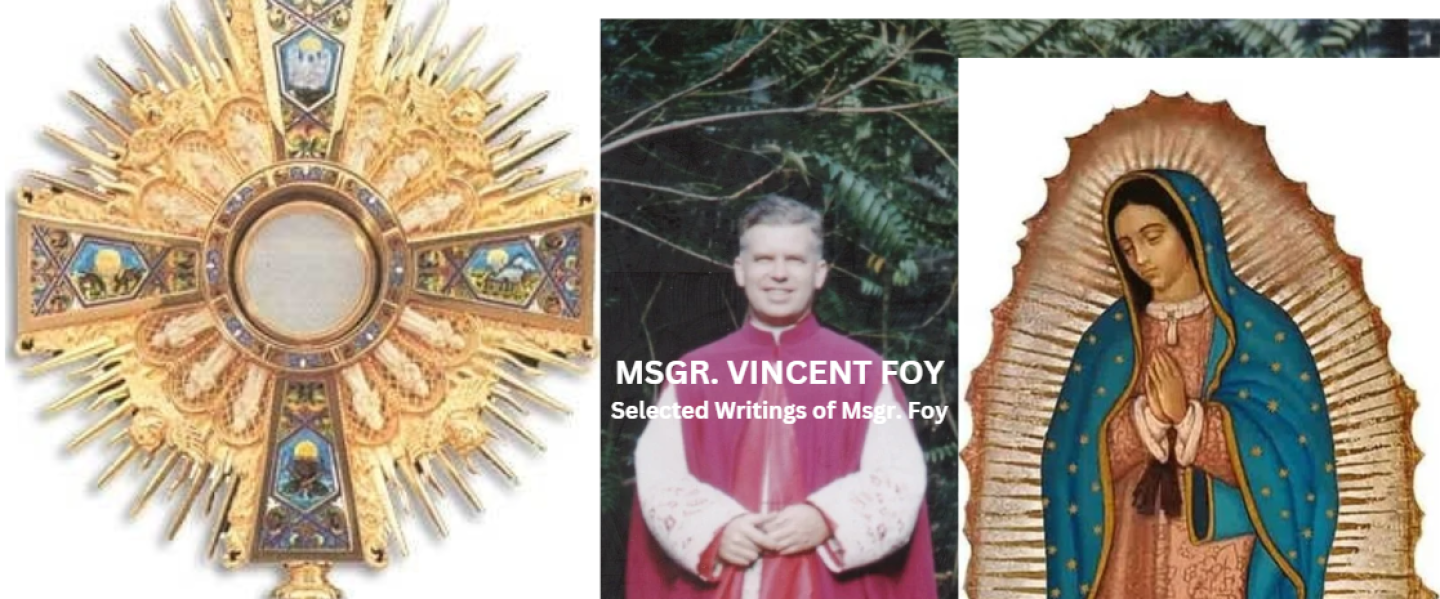

Sermon by Rev. Msgr. Vincent Nicholas Foy (August 14, 1915 – March 13, 2017) preached at Holy Martyrs of Japan parish, in Bradford, ON on Holy Thursday, 1952. Published in commemoration of and to celebrate + Msgr. Foy’s 86th ordination anniversary (June 3, 1939 – June 3, 2025).

Part 1: A Holy Thursday Custom
My dear brethren, in cities all over the world today, Catholics in their thousands and tens of thousands have been visiting Our Blessing Lord in the Eucharist in seven different churches. If we were to study the history of this devotion, we would find that it goes back to early Christian times when Christians of Rome on Holy Thursday visited the seven principal churches of Rome. And what was the inspiration of this devotion? It was that on the first Holy Thursday, the eve of the day of our redemption by blood, there was given to the human race the Supreme gift of Christ in the Eucharist.
Once more, this evening, we celebrate the anniversary of one of the truly great events in human history, the institution of the Blessed Eucharist. What is more fitting than that we should review the history of its foundation, and consider something of its importance to us?
Part 2: The Promise
On the north side shore of the little sea of Galilee in Palestine there are the ruins of the ancient town of Capharnaum. Among the ruins are those of the synagogue which stood in the time of Christ. It was here that Our Blessed Lord gave the promise of the Blessed Eucharist to the world. We are told what happened in the Gospel of Saint John. Here it was that Christ said “I am the bread of life. Your fathers did eat manna in the desert and are dead. But whosoever shall eat of the bread that I shall give shall live forever. And the bread that I will give is My flesh for the life of the world.”
And we are told that the Jews began to argue and murmur among themselves saying: “How can this man give us his flesh to eat?”
Jesus replied simply and plainly: “Amen. Amen. I say unto you: except you eat of the flesh of the Son of man and drink His blood, you shall not have life in you. He that eateth My flesh and drinketh My blood abide is in Me and I in him.”
St. John adds: “These things he said, teaching in the synagogue in Capharnaum.”
Many of the disciples of Jesus, hearing His words said, “This saying is hard, and who can hear it” and they walked no more with him.
Jesus had tested their faith. He did not call them back when their faith had failed, but He returned to the twelve apostles and said: Will you also go away? And Simon Peter answered Him: “Lord, to whom shall we go? Thou hast the words of eternal life. And we have believed and have known that thou art the Christ, the Son of God.”
The apostles did not understand Christ’s promise: but they knew him to be God and that what he had promised would come to pass: that they would one day eat the flesh of God.
Part 3: The Fulfilment
The fulfilment of that promise was soon to come. Its fulfilment takes us to the scene of the Last Supper which was also the first Eucharistic Banquet.
Christ and His twelve apostles are reclining at the Paschal table. Our Lord knows as He reclines there that within a day every drop of blood will be drained from His veins. He knows that in the pouch of Judas is already the blood money of thirty pieces of silver, the price of the Son of God. He knows that already it has been agreed upon that He should be betrayed by a kiss. Around Christ in the hearts of Judas, the High Priests, the scribes and the pharisees, the emotion of hate is welling stronger. Around Christ the atmosphere is heavy with hate. Yet here is the seeming contradiction. While men were planning the greatest act of hate, Christ gave us the greatest gift of His love. At the very moment when the Jewish leaders were trying to remove Jesus from among the people, Our Lord instituted the means by which He would stay with them until the end of time.
So surrounded by hate, in Christ himself at the Last Supper there is only love. He says: “A new commandment I give unto you, that you love one another, as I have loved you.” And then He says, “With desire I have desired to eat this Pasch with you, before I suffer.” And taking bread into his hands He says: “Take ye and eat; This is My Body” in taking wine He says: “This is My Blood of the New Testament, which shall be shed for many” and “Do this in commemoration of me.”
So it was that Christ made His last Will and Testament before He died, bequeathing to us the supreme gift of love, the supreme memorial and food of the Eucharist to stay with us forever.
Part 4: The Eucharist – The Sacrament of Love
It is appropriate that today, the anniversary of the institution of the Blessed Eucharist, we should, consider its most outstanding characteristic. It is above all else, the Sacrament of Love. It was inspired by God’s love, and its chief purpose is to foster in us in return, love for God. When Christ was promising the Eucharist, He said, as recorded by St. John: “As the living Father hath sent Me and I live by the Father: so He that eateth Me, the same also shall live by Me.” Those who ate Christ were to live by him. That is, in His love and the love of God.
So we say that the Sacramental grace given in the reception of Holy Communion, i.e. the special grace peculiar to this sacrament, is an increase in charity, i.e. of the love of God. Now we know that charity is always present in our souls when we are in a state of grace. What the Sacramental grace of Holy Communion does, however, is to give us the spiritual grace to make the charity in us operative, to put it to action. We are given grace to love God actively.
What does this mean?
- First, we are drawn closer to God in Himself. We are given the grace to make acts of love of God. We are given the grace to see better God’s beauty and goodness, His love, His mercy, His greatness.
- Secondly, because of the increased love of God we are drawn to do His will. Christ said, “He that eateth Me, keepeth my Commandments.” So, the grace of Holy Communion helps us to see sin for what it is, the abomination of abominations. Its deceitfulness is laid bare. With the strength of God’s love, we realize that sin promises much and gives worse than nothing. It may look bright but is black, attractive when it is poisonous. The grace of God’s love received in Holy Communion teaches us that sin is a deceit, an illusion, a deception, a trap, and snare.
- Thirdly, my dear brethren, the grace to love God-given in Holy Communion brings with it charity towards our neighbour. To love God means to love those whom He loves. God loves every human soul. So, we also must love every human soul. The grace to do this is given in Holy Communion: the grace to see beyond the imperfections in our neighbour, to see in them the image of God, to see in their souls for whom Christ died, to see in them the common blood of our first parents, brothers and sisters everyone of them, to be loved, forgiven, helped and prayed for.
These are the graces of the sacrament of love: the grace to love God in Himself and for Himself; the grace to love God by keeping His Commandments; the grace to love God through loving others.
Part 5. We All Need the Grace of Holy Communion
Which of us, my dear brethren, does not need the grace to love God more, so that His love will more in more penetrate our lives and transform them into what they were meant to be. Which of us does not the grace to strengthen wavering wills so that they will keep the commandments of God and his church, stand firm in the terrible times of temptation, see the evil of sin for what is, see in the law of God a loving plan for eternal happiness? Which of us does not need the grace of God to love Him through loving our neighbour? Which of us does not need the charity to cast out unkind thoughts, the charity to seal our lips against the expression of all hate, all calumny, all detraction, all spite, and unkindness, all sharp and hurting words? Which of us does not need the charity to stay the impulses to uncharitable actions which destroy the love of God? Which of us does not need the grace to practise positive charity, to give to the poor, to help and visit the sick and the bereaved, to contribute to the work of the missions, within our means, to encourage every good work, to pray for sinners, for the souls in purgatory, for the dying, for the conversion of the world, for the coming of Christ’s Kingdom on earth? Which of us does not need the charity to live in peace and love and kindness with those of one’s own household?
My dear brethren, the graces for every one of these types and manifestations of charity are to be obtained at the Communion rail in this church, through the worthy reception of Holy Communion, the Sacrament of Divine Love.
“Take ye and eat” said Christ to His Apostles on the first Holy Thursday.
“Take ye and eat” says Christ to us on this anniversary of that day.
What more acceptable wreath could we lay before Christ in the Blessed Sacrament today than the firm resolve to receive Holy Communion more frequently, or if that is not possible, with better dispositions? Such a resolve will place our feet more firmly on the way to a greater love of God, of His will, and greater love of our neighbour. It will also place our feet firmly on the road to our own salvation. Pope Pius X … used to say, “Beloved children, the surest, easiest, shortest way to heaven is by the Holy Eucharist” and today on the anniversary of the institution of the Sacrament of Love, we say in the words of Saint Paul: “Thanks be to God for His unspeakable gift” (II Cor. IX), Amen.
This handwritten sermon by + Msgr. Vincent Nicholas Foy, was typed for the first time on Ash Wednesday, March 5, 2025, by Staff of PERPETUAL EUCHARISTIC ADORATION www.perpetualeucharisticadoration.com
Msgr. Foy’s handwritten notes can be viewed HERE.

You must be logged in to post a comment.