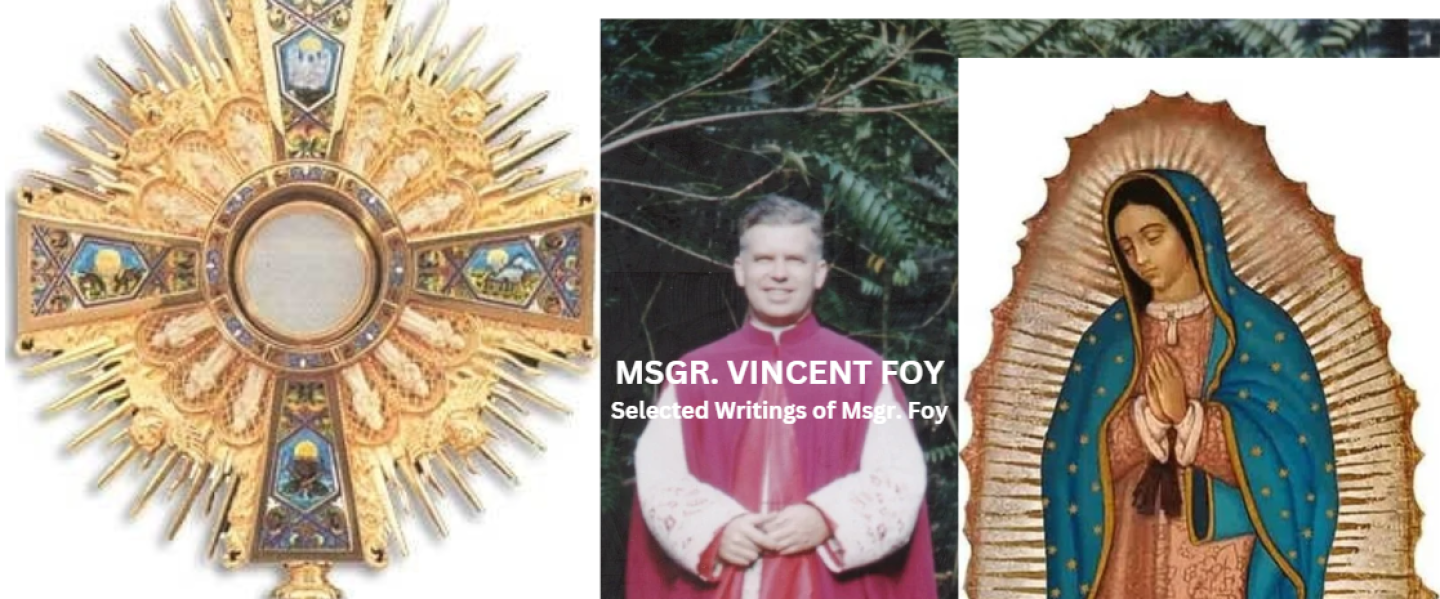
Msgr. Vincent Foy: Champion for Life on EWTN – Jan. 21 & 24, 2026

Preview above of the thirty minute tribute promoting the heroic virtue of “Msgr. Vincent Foy, Champion for Life” which will be aired again on Eternal Word Television Network on Wednesday, January 21 at 5:30 p.m. and Saturday, January 24 at 11:30 a.m: EWTN Watch.

“Msgr. Vincent’s Foy’s untiring defense of Catholic teachings on marriage and family earned his a papal commendation and the Pro-Life Man of the Year award.”

As we celebrate the 57th Anniversary of Humanae vitae in 2026, please consider printing and sharing copies of his complementary article/pamphlet “Contraception – Why Not?” with others.

Link to printable copy:  Contraception – Why Not?

Note:

Miracles obtained through the intercession of Msgr. Foy can be reported through this website. The more scientific evidence or instantaneous, the better.  For canonization, the Church requires that the prayer for a miracle must be made only to the one person/intercessor, so that it can be certain that the miracle was not due to another saint. For example, for the miracle to count, you can’t have prayed for this miracle to Our Lady and St. Anthony, as well as asking for the intercession of a candidate for canonization.  This is because if you obtain the miracle you are praying for, the Church cannot be certain to attribute it directly and only to the candidate’s intercession.

Msgr. Foy received all of the Sacraments regularly and before he died, including the Apostolic Blessing.

In charity, Msgr. Foy offered and sacrificed his life and vocation for the salvation and sanctification of souls.  He is a true Champion for Eternal Life and for Eucharistic and Perpetual Adoration: www.perpetualeucharisticadoration.com.

Dispositions for Receiving Holy Communion

Sermon by Rev. Msgr. Vincent Nicholas Foy (August 14, 1915 – March 13, 2017)

preached at St. Michael’s Cathedral, Toronto, ON,

on Sunday, November 23, 1958

Photo: August 14, 2014 – Msgr. Foy’s 99th birthday, Fr. Ed and Fr. Roche

Part 1: Introduction

Part 2: Necessary Dispositions

Part 3: Desirable Disposition – Preparation

Part 4: Desirable Disposition – Thanksgiving

Part 5: Conclusion

Part 1 Introduction

My dear brethren, we all recognize the value of reviews. Our memories are faltering and failing faculties need constantly to be refreshed. Most of us have forgotten many of the poems we memorized at school; we have forgotten a great deal of the algebra, geometry, physics, and other subjects of high school. It is the same with our religious instruction. We have forgotten many of the catechism answers which once came so readily to our lips. It is therefore useful to us to continually review the principles of our faith, to impress them ever more deeply in the grooves of our minds. To widen the grooves by wider spiritual reading and reflection, for the doctrines of our faith and the principles of the spiritual life are the really important guides in our lives.

This evening, we will open up our catechism, as it were, and reflect upon one of the questions explained to us long ago. The question was asked in our catechism: “How must we be prepared for Holy Communion?”

What could be more important to our spiritual life than the answer to this question?

In the Blessed Eucharist we have the true manna and bread from heaven, sometimes called the Bread of angels. When properly received Holy Communion brings a surging of new life to the soul through an increase of sanctifying grace, the greatest treasure we can possess next to the state of grace itself. It unites us to God in the most intimate way possible in this life, as one saints says, more closely than two pieces of wax which when melted become one. It strengthens us mightily against the temptations which would ravage our souls and leave them without God. It promotes the virtues which make up the image of Christ. It is a pledge of our future glory and eternal life.

There are the fruits when it is properly received.

It is therefore a great and important question which our catechism asked and answered: “How must we be prepared for Holy Communion?”

Part 2: The Necessary Dispositions

When we answer this question, we find there are two parts of it. One part gives us the necessary dispositions for Holy Communion. The other part gives us the desirable dispositions.

The first necessary disposition is that we must be in the state of grace. The Holy Eucharist is what is called a sacrament of the living, for those already united to God by the state of grace, the bond of charity. Food is not for the dead, it is for the living. The soul in the fetters of sin is a dead soul. Sin changes what should be spiritual food into spiritual poison. The Bread of Life becomes the Bread of Death. St. Paul reminds us: “He who eats and drinks unworthily eats and drinks judgment to himself.”

It is true that a person in the state of mortal sin may gain the state of grace by an act of perfect contrition, i.e. an act of contrition made from the love of God, plus the intention of going to Confession as soon as conveniently possible. However, such a person may still not receive Holy Communion until absolved in the sacrament of penance.

The second necessary disposition is that we must know and realize what we receive in Holy Communion. We must know and realize it is Jesus Christ we take into our hearts. Thus, children who have not the use of reason may not receive. Nor may the insane receive Holy Communion. Nor may the sick who have lapsed into unconsciousness or cannot appreciate that the Eucharist is the Body and Blood of Christ.

[2025 note of typist: This Latin rite sermon was preached in 1958. In the Eastern rite, infants may receive all of the sacraments of initiation – Baptism, Communion and Confirmation. Later on, parents may withhold their children from receiving the Eucharist until after they make their First Confession at the age of reason. For example, a local custom in Byzantine Catholic schools is to follow the Latin rite by not having Grade1 and 2 students receiving Holy Communion, until they after their First Confession in Grade 2. Perhaps in the Latin rite there are concerns with infants vomiting or burping up Holy Communion, or that children can commit mortal sin before they receive their First Confession?]

The third necessary disposition is that we must be fasting according to the laws of the Church. Exceptions of course must be made for the reception of Holy Viaticum by the dying and in extraordinary cases, e.g. to avoid the profanation or desecration of the Eucharist.

Ordinarily, one must be fasting. To promote more frequent Holy Communion the laws of the Eucharistic Fast have undergone radical changes in the last few years, first in 1953 by the Apostolic Constitution “Christus Dominus” and then in 1957 on March 19, by the Moto Proprio of Pope Pius XII called “Sacram Communionem”.

The old law of fasting from midnight we know has been abolished.

We now compute the time of fast from the moment of receiving Holy Communion. A three-hour fast, counting back from the moment of Communion must be kept with regard to solid food and alcoholic liquids. A one hour fast, counting back from the moment of Communion, must be kept with regards to all liquid nourishment. Water never breaks the fast. Every reception of Holy Communion is regulated by the above laws, whether it is received in the morning, evening or at midnight.

There are special privileges for the sick, even though they are not bedridden. The sick must, like others, observe the three-hour fast from solid nourishment. However, true medicine, may be taken either in liquid or solid form, at anytime before Holy Communion. Likewise, the sick may take non-alcoholic liquid nourishment anytime, prior to Holy Communion. Again, water never breaks the fast. In the new legislation, no permission or consultation of the Confessor is required in order to avail oneself of these concessions. However, we should not forget that the Holy Father urged all who felt able, to observe the old Eucharistic laws of fast. If one does not do so, he should try to compensate in other ways, especially by works of penance and charity.

Part 3: Desirable Disposition – Preparation

Now we come to the dispositions for Holy Communion which cannot be called necessary, but which are most important for the fruitful reception of Holy Communion. These may be summed up under two headings: Preparation and Thanksgiving.

We can readily see the necessity and the propriety of preparing our souls to receive our Creator in a fitting manner.

Moses had the Ark of the Covenant built from the most precious wood and had it plated with gold. Why? Because it was to contain the two tablets of the Lord, which had come from God – the two tablets of the Ten Commandments.

For seven years Solomon and workers labored in the construction of the Temple of Jerusalem, choosing only precious wood, marble and stone, and lavishing gold upon the walls. Some question this saying: “Why such extravagance?” Solomon’s reply was: “I am building a house not for man but for God.”

If such care was bestowed upon preparing the Ark of the Covenant and upon the Temple of Jerusalem, what about our souls? When we receive Holy Communion, we receive the Living God. We become Living Arks and Living Tabernacles. For this privilege we should prepare ourselves.

How do we prepare? We do so by … exercising the virtues which are in the soul in the state of grace, by making acts of Faith, Hope, Charity, humility, and sorrow. We make an act of Faith when we say: “Lord I believe.”  The Eucharist is the “Mystery of Faith.” Our faith can never be too great. We must repent “I believe Lord, increase my faith.”  We make an act of hope for the graces that Christ has promised to those who eat His flesh and drink His Blood. We make an act of love by making our own the words of Saint Peter: “Lord, Thou knowest that I love Thee.” The Eucharist is the sacrament of love. It is God’s great proof of His love and inspires in us a love in return. We make an act of humility when we acknowledge that of ourselves, we have nothing but sin to our name and that all that is good in us and around us comes from the All Holy God we are to receive. So we say with the priest: “Lord I am not worthy that thou shouldst enter under my roof but only say the word and my soul shall be healed.” We make an act of sorrow for sin when we recite the Confiteor with the priest: when we make an act of contrition and ask Christ in the words of the Psalmist: “Create a clean heart in me, Oh God.”

So should we prepare to receive Our God with the tabernacle of our heart: in faith, hope, charity, humility, and compunction.

Part 4: Desirable Disposition – Thanksgiving

The other important disposition for Holy Communion is a suitable Thanksgiving. The time after Holy Communion, when we have within us the Divine Guest, is the most fruitful and beneficial. We should profit by these moments.

How do we go about making our Thanksgiving? In a way parallel to our preparation for Communion. We should unite with Our Blessed Mother, with the Angels and Saints in adoring Christ present within us.

We must thank Our Divine Guest for coming to spend these minutes with us, minutes so rich in goodness and sanctification.

We should express our love for Him who sanctified Himself for our salvation.

We should beg His graces, because Christ in Holy Communion comes laden with all the treasures of His divinity and comes in willingness to bestow these upon us. With humility, confidence and hope we should request a sharing in these.

We should make resolutions for the future, to progress in virtue and to adhere ever more firmly to God’s Will and Commandments. For our preparation for Communion and our Thanksgiving we may use books. These however, must never supplant the interior acts of devotion – for upon these really depend the fitting reception of our Lord.

Part 5: Conclusion

So my dear brethren we have reviewed the question: “How must we be prepared for Holy Communion?”

We realize how important Holy Communion is in our lives. Napoleon, who wandered far from the orbit of God’s Will in his day, when he was at the height of his influence once asked his generals: “Do you know what was the happiest day of my life?” One general replied: “It was the uniting at marriage.” Another said: “It was the battle of the pyramids.” A third replied: “It was the glamorous meeting at Austerlitz.” Napoleon replied in a loud voice: “No it was the day of my First Holy Communion.” And we know that when at last God’s hand punished Napoleon’s pride and he was in prison on the island of St. Helena, he prepared children for their First Holy Communion.

How many of us look back in the day of our first Holy Communion on the happy as the happiest day of our lives!

In our pilgrimage through this life, if we gaze with the eyes of faith, we see that the really great moments in our lives, above all others, standing like mountains against the valleys, were the moments when we were one with Christ Our God in Holy Communion. For these moments provide for us, if we are there properly, the greatest opportunities for fixing in us the path of God’s will, for taking giant steps in charity, and for sealing our salvation. Holy Communion is the pledge of our future glory.

“Your fathers did eat manna in the desert” said Christ, “and are dead. “But if any man eat of the bread that I shall give he shall live forever.”

May these thoughts stir us to reap the fruits of Holy Communion by receiving it with the necessary dispositions and with proper preparation and thanksgiving.

Amen.

This handwritten sermon was typed for the first time by the APOSTOLATE OF EUCHARISTIC ADORATION www.perpetualeucharisticadoration.com, on August 11, 2025, in commemoration of +Msgr. Vincent Foy’s  birthday on August 14.

Photo above: pro-life lawyer Gwen Landolt humbly greeting Msgr. Foy on his 100th birthday. Photos below: live entertainment and laughs.

PDF copy of this sermon HERE.

His handwritten notes can be viewed on his website MSGR. VINCENT FOY – Selected Writings of Msgr. Vincent Nicholas Foy at this link HERE.

Many thanks to Catholic Insight for also publishing this sermon today at this link: https://catholicinsight.com/2025/08/14/dispositions-for-receiving-holy-communion/

After a long day working at the chancery offices, Msgr. Foy would travel far to be the guest preacher at Forty Hour devotions with exposition at parishes. He was a co-founder and director of this charity, which assists parishes with expanding Eucharistic and perpetual adoration.   Msgr. Foy is known as the longest ordained and oldest diocesan priest in the history of the Archdiocese of Toronto and the longest ordained Anglophone diocesan priest in the history of Canada. Worldwide, four served longer.

The Eucharist: Sacrament of Love

Sermon by Rev. Msgr. Vincent Nicholas Foy (August 14, 1915 – March 13, 2017) preached at Holy Martyrs of Japan parish, in Bradford, ON on Holy Thursday, 1952. Published in commemoration of and to celebrate + Msgr. Foy’s 86th ordination anniversary (June 3, 1939 – June 3, 2025).

Part 1: A Holy Thursday Custom

My dear brethren, in cities all over the world today, Catholics in their thousands and tens of thousands have been visiting Our Blessing Lord in the Eucharist in seven different churches. If we were to study the history of this devotion, we would find that it goes back to early Christian times when Christians of Rome on Holy Thursday visited the seven principal churches of Rome. And what was the inspiration of this devotion? It was that on the first Holy Thursday, the eve of the day of our redemption by blood, there was given to the human race the Supreme gift of Christ in the Eucharist.

Once more, this evening, we celebrate the anniversary of one of the truly great events in human history, the institution of the Blessed Eucharist. What is more fitting than that we should review the history of its foundation, and consider something of its importance to us?

Part 2: The Promise

On the north side shore of the little sea of Galilee in Palestine there are the ruins of the ancient town of Capharnaum. Among the ruins are those of the synagogue which stood in the time of Christ. It was here that Our Blessed Lord gave the promise of the Blessed Eucharist to the world. We are told what happened in the Gospel of Saint John. Here it was that Christ said “I am the bread of life. Your fathers did eat manna in the desert and are dead. But whosoever shall eat of the bread that I shall give shall live forever. And the bread that I will give is My flesh for the life of the world.”

And we are told that the Jews began to argue and murmur among themselves saying: “How can this man give us his flesh to eat?”

Jesus replied simply and plainly: “Amen. Amen. I say unto you: except you eat of the flesh of the Son of man and drink His blood, you shall not have life in you. He that eateth My flesh and drinketh My blood abide is in Me and I in him.”

St. John adds: “These things he said, teaching in the synagogue in Capharnaum.”

Many of the disciples of Jesus, hearing His words said, “This saying is hard, and who can hear it” and they walked no more with him.

Jesus had tested their faith. He did not call them back when their faith had failed, but He returned to the twelve apostles and said: Will you also go away? And Simon Peter answered Him: “Lord, to whom shall we go? Thou hast the words of eternal life. And we have believed and have known that thou art the Christ, the Son of God.”

The apostles did not understand Christ’s promise: but they knew him to be God and that what he had promised would come to pass: that they would one day eat the flesh of God.

Part 3: The Fulfilment

The fulfilment of that promise was soon to come. Its fulfilment takes us to the scene of the Last Supper which was also the first Eucharistic Banquet.

Christ and His twelve apostles are reclining at the Paschal table. Our Lord knows as He reclines there that within a day every drop of blood will be drained from His veins. He knows that in the pouch of Judas is already the blood money of thirty pieces of silver, the price of the Son of God. He knows that already it has been agreed upon that He should be betrayed by a kiss. Around Christ in the hearts of Judas, the High Priests, the scribes and the pharisees, the emotion of hate is welling stronger. Around Christ the atmosphere is heavy with hate. Yet here is the seeming contradiction. While men were planning the greatest act of hate, Christ gave us the greatest gift of His love. At the very moment when the Jewish leaders were trying to remove Jesus from among the people, Our Lord instituted the means by which He would stay with them until the end of time.

So surrounded by hate, in Christ himself at the Last Supper there is only love. He says: “A new commandment I give unto you, that you love one another, as I have loved you.” And then He says, “With desire I have desired to eat this Pasch with you, before I suffer.” And taking bread into his hands He says: “Take ye and eat; This is My Body” in taking wine He says: “This is My Blood of the New Testament, which shall be shed for many” and “Do this in commemoration of me.”

So it was that Christ made His last Will and Testament before He died, bequeathing to us the supreme gift of love, the supreme memorial and food of the Eucharist to stay with us forever.

Part 4: The Eucharist – The Sacrament of Love

It is appropriate that today, the anniversary of the institution of the Blessed Eucharist, we should, consider its most outstanding characteristic. It is above all else, the Sacrament of Love. It was inspired by God’s love, and its chief purpose is to foster in us in return, love for God. When Christ was promising the Eucharist, He said, as recorded by St. John: “As the living Father hath sent Me and I live by the Father: so He that eateth Me, the same also shall live by Me.” Those who ate Christ were to live by him. That is, in His love and the love of God.

So we say that the Sacramental grace given in the reception of Holy Communion, i.e. the special grace peculiar to this sacrament, is an increase in charity, i.e. of the love of God. Now we know that charity is always present in our souls when we are in a state of grace. What the Sacramental grace of Holy Communion does, however, is to give us the spiritual grace to make the charity in us operative, to put it to action. We are given grace to love God actively.

What does this mean?

  1. First, we are drawn closer to God in Himself. We are given the grace to make acts of love of God. We are given the grace to see better God’s beauty and goodness, His love, His mercy, His greatness.
  2. Secondly, because of the increased love of God we are drawn to do His will. Christ said, “He that eateth Me, keepeth my Commandments.” So, the grace of Holy Communion helps us to see sin for what it is, the abomination of abominations. Its deceitfulness is laid bare. With the strength of God’s love, we realize that sin promises much and gives worse than nothing. It may look bright but is black, attractive when it is poisonous. The grace of God’s love received in Holy Communion teaches us that sin is a deceit, an illusion, a deception, a trap, and snare.
  3. Thirdly, my dear brethren, the grace to love God-given in Holy Communion brings with it charity towards our neighbour. To love God means to love those whom He loves. God loves every human soul. So, we also must love every human soul. The grace to do this is given in Holy Communion: the grace to see beyond the imperfections in our neighbour, to see in them the image of God, to see in their souls for whom Christ died, to see in them the common blood of our first parents, brothers and sisters everyone of them, to be loved, forgiven, helped and prayed for.

These are the graces of the sacrament of love: the grace to love God in Himself and for Himself; the grace to love God by keeping His Commandments; the grace to love God through loving others.

Part 5. We All Need the Grace of Holy Communion

Which of us, my dear brethren, does not need the grace to love God more, so that His love will more in more penetrate our lives and transform them into what they were meant to be. Which of us does not the grace to strengthen wavering wills so that they will keep the commandments of God and his church, stand firm in the terrible times of temptation, see the evil of sin for what is, see in the law of God a loving plan for eternal happiness? Which of us does not need the grace of God to love Him through loving our neighbour? Which of us does not need the charity to cast out unkind thoughts, the charity to seal our lips against the expression of all hate, all calumny, all detraction, all spite, and unkindness, all sharp and hurting words? Which of us does not need the charity to stay the impulses to uncharitable actions which destroy the love of God? Which of us does not need the grace to practise positive charity, to give to the poor, to help and visit the sick and the bereaved, to contribute to the work of the missions, within our means, to encourage every good work, to pray for sinners, for the souls in purgatory, for the dying, for the conversion of the world, for the coming of Christ’s Kingdom on earth? Which of us does not need the charity to live in peace and love and kindness with those of one’s own household?

My dear brethren, the graces for every one of these types and manifestations of charity are to be obtained at the Communion rail in this church, through the worthy reception of Holy Communion, the Sacrament of Divine Love.

“Take ye and eat” said Christ to His Apostles on the first Holy Thursday.

“Take ye and eat” says Christ to us on this anniversary of that day.

What more acceptable wreath could we lay before Christ in the Blessed Sacrament today than the firm resolve to receive Holy Communion more frequently, or if that is not possible, with better dispositions? Such a resolve will place our feet more firmly on the way to a greater love of God, of His will, and greater love of our neighbour. It will also place our feet firmly on the road to our own salvation. Pope Pius X … used to say, “Beloved children, the surest, easiest, shortest way to heaven is by the Holy Eucharist” and today on the anniversary of the institution of the Sacrament of Love, we say in the words of Saint Paul: “Thanks be to God for His unspeakable gift” (II Cor. IX), Amen.

This handwritten sermon by + Msgr. Vincent Nicholas Foy, was typed for the first time on Ash Wednesday, March 5, 2025, by Staff of PERPETUAL EUCHARISTIC ADORATION www.perpetualeucharisticadoration.com

Msgr. Foy’s handwritten notes can be viewed HERE.

PDF of this sermon