I was recently contacted with concerns that some clergy and laity need to be reminded that they should genuflect when they pass by the Tabernacle. In response, I am posting the following sources in support of the reception of Holy Communion on the tongue, kneeling, genuflecting, the restoration of Communion rails, centrally-placed Tabernacles and having the priest celebrant face the Tabernacle and worship God with the people at Mass. These have been longtime traditions of the Roman Rite of the Catholic Church.
Kneeling “officially signifies adoration” (Ceremonial of Bishops, Nos. 68-72 p.36-37).
“One waits for symbols and promises standing, but the Reality, one receives with love and on one’s knees” (Pope Saint Pius X).
“The Catholic Church has always offered and still offers the worship of latria [adoration] to the Sacrament of Eucharist” (Pope Paul VI, Mysterium Fidei, 1965, n.56).
“No one eats of this flesh without having first adored it and not only do we not sin by adoring but we would sin by not adoring” (Ibid., n.55, St. Augustine, In Ts, Ch.98, 9:PL 37, 126).
To Adore God in keeping with longstanding tradition of the Church:
1. Restore and bring about increased, more humble and fervent love, adoration, reverence and thanksgiving for Jesus in the Holy Eucharist through receiving Holy Communion worthily and in the best way possible, while kneeling and on the tongue. (The communicant must of course, always be in a state of grace, having received absolution in the Sacrament of Penance for any and all mortal/serious sins).
2. Promote and defend kneeling at the appropriate times during the Holy Sacrifice of the Mass, especially during the Consecration, and to renew the venerable practise of genuflecting and kneeling before the Blessed Sacrament.
3. Restore and encourage central Tabernacles and the celebration of Mass facing the Lord with the congregation where still needed.
History:
“The theme of the project was that Communion-in-the-hand and standing for Communion were not consonant with the two-millennia-long Catholic tradition and that both practices need to be re-evaluated for the good of the Church… When Communion-in the-hand was being proposed and practiced illicitly in the mid-1960s, the argument was proffered that this was merely a return to the ‘ancient’ usage of the Church, one that would enhance the faith-life of the Church… With the publication of Memoriale Domini in 1967, it was abundantly clear that Pope Paul VI did not accept such a view, nor did the world-wide episcopate, who resoundingly opposed any change in the method of Communion distribution…” (Dominus Est – It is the Lord!, Most Reverend Athanasius Schneider, Preface)
The Church throughout centuries: To preserve and defend reverence, dignity and holiness due to the greatest treasure in the Church, only kneeling, not standing, to receive Holy Communion, always on the tongue, was allowed. “This method, ‘on the tongue’ must be retained” (Pope Paul VI, Memoriale Domini, 1969).
Communion in the hand comes from the Dutch Calvinists of the 17th Century. Calvinism denies the real presence of Christ in the Host. Communion in the hand wasn’t even practiced by the Lutherans: Even “The Lutherans have until quite recently, and till today in Scandinavian lands, preserved communion kneeling and on the tongue” (August 12, Bishop Athanasius Schneider: 2011, http://eponymousflower.blogspot.ca/2011/08/auxiliary-bishop-says-communion-in-hand.html).
St. Basil (330-379 AD): considered Communion in the hand a “great fault”.
Council of Rouen (650 AD): Do not put the Eucharist in the hands of any layperson, but only in their mouths.
Council of Constantinople (695 AD): prohibited the faithful from giving Communion to themselves.
St. Thomas Aquinas (1224-740): “Out of reverence towards this Sacrament, nothing touches It but what is consecrated” (Summa, Pt. III, Q.82, Art.3).
“All that has been elaborated on until now permits us to realize that the history of the reintroduction of communion in the hand is nothing other than the triumph of an act of disobedience” (Communion in the Hand: Documents and History, Most Rev. Juan Rodolfo Lais, Bishop Emeritus of San Luis, Argentina, 2011).
Sacred Scripture: “Every Knee shall be bowed to Me” (Is 45:23). “As I live, saith the Lord, every knee shall bend before Me” (Rom 14:11). “Every knee must bend, in heaven and on earth and under the earth” (Phil 2:10).
Authoritative Statements and References:
Pope Benedict XVI and the Congregation for Divine Worship and the Discipline of the Sacraments:
“It is the mission of the Congregation for Divine Worship and Sacraments to work to promote Pope Benedict’s emphasis on the traditional practices of liturgy, such as reception of Communion on the tongue while kneeling (Cardinal Llovera, Prefect for the Vatican’s Congregation for Divine Worship, July 22, 2009).
“We Christians kneel only before God or before the Most Blessed Sacrament because we know and believe that the one true God is present in It, the God Who created the world and so loved it that He gave His Only Begotten Son (cf. Jn 3:16)” (Pope Benedict XVI, Corpus Christi Homily, Rome, June 13, Zenit.org).
“By bringing back traditional postures in the reception of Holy Communion when the Pope celebrates Mass, (among other things) he is hoping to bring back to the faithful this sense of sacredness in divine worship.” The custom of worshippers receiving “Holy Communion kneeling and on the tongue, from Pope Benedict” in Rome has extended to outside the Vatican (Inside the Vatican, Return to Traditions at World Youth Day, August/September 2008).
“In continuity with the teaching of his Predecessor, starting with the Solemnity of Corpus Christi in the year 2008, the Holy Father, Benedict XVI, began to distribute to the faithful the Body of the Lord, [only] by placing it directly on the tongue of the faithful as they remain kneeling” (Office for the Liturgical Celebrations of the Supreme Pontiff, http://www.vatican.va).
“If a child were to see somebody kneeling devoutly at a communion rail, receiving Communion from a priest on his tongue, with an Altar boy holding a paten under his chin, the child would know something special is happening. The child would know that the man has faith in something: he is a believer in the Real Presence of Christ in the Eucharist” (Referring to Theology of Kneeling, Ignatius Press, 2000, pp 88-90, Cardinal Ratzinger, Prefect, CDF, Fr. Edgardo Arellano, Kneeling – The Most Appropriate Posture in Receiving the Eucharist according to the Popes, the Bible, the Fathers of the Church, the Sacred Congregation for the Doctrine of the Faith, and the Sacred Congregation for Divine Worship).
“It is the sign of adoration that needs to be recovered. I think the entire Church needs to receive Communion while kneeling” (Cardinal Llovera, Prefect for the Vatican’s Congregation for Divine Worship and the Discipline of the Sacraments, July 2011).
For the Novus Ordo Mass, the General Instruction of the Roman Missal lays down the following rules for genuflections during Mass:
“Genuflections and Bows
- A genuflection, made by bending the right knee to the ground, signifies adoration, and therefore it is reserved for the Most Blessed Sacrament, as well as for the Holy Cross from the solemn adoration during the liturgical celebration on Good Friday until the beginning of the Easter Vigil.
During Mass, three genuflections are made by the priest celebrant: namely, after the showing of the host, after the showing of the chalice, and before Communion. Certain specific features to be observed in a concelebrated Mass are noted in their proper place (cf. nos. 210-251).
If, however, the tabernacle with the Most Blessed Sacrament is present in the sanctuary, the priest, the deacon, and the other ministers genuflect when they approach the altar and when they depart from it, but not during the celebration of Mass itself.
Otherwise all who pass before the Most Blessed Sacrament genuflect, unless they are moving in procession.”
“If a priest celebrant goes to the tabernacle to remove the Blessed Sacrament (e.g. due to the number of communicants) and that tabernacle is not directly behind the altar, I would have expected him to genuflect; I don’t think the GIRM in saying ‘three genuflections are made by the priest’ is saying in that instance he should not make another genuflection, just that he must (infirmity aside) make those three genuflections. He is not just passing in front of it, he is approaching and removing the Blessed Sacrament.” http://wdtprs.com/blog/2012/01/quaeritur-genuflecting-before-a-tabernacle/
The traditional Latin Mass requires more numerous genuflections to the Blessed Sacrament during Mass.
“No one who enters a Church should fail to adore the Blessed Sacrament either by visiting the Blessed Sacrament chapel or at least by Genuflecting. Similarly those who pass before the Blessed Sacrament genuflect, except when they are walking in procession” (The Ceremonial of Bishops, No. 71, 1984).
“Starting from his [Pope Benedict XVI’s} experience, which aroused in him a great faith, wonder, and devotion for the Lord present in the Eucharist, he presents us with an historical-theological excursus that clarifies how the practise of receiving Holy communion on the tongue, while kneeling, became the normative practise in the Church… I think it is now time to evaluate carefully the practise of communion-in-the-hand… to abandon what was actually never called for by the Vatican II document Sacrosanctum Concilium nor by the council Fathers but was, in fact, ‘accepted’ after it was introduced as an abuse in some countries” (Most Reverend Malcolm Ranjith, Secretary for the Congregation for Divine Worship and the Discipline of the Sacraments, as quoted in Dominus Est – It is the Lord!, Most Reverend Athanasius Schneider, 2008. This book was recommended by Cardinal Arinze as Prefect of the Congregation for Divine Worship who declared: “I have read the whole book with delight. It is excellent”).
Cardinal Raymond Burke, Prefect of the Supreme Tribunal of the Apostolic Signatura: “The Holy Father reminds bishops of their duty to reaffirm the relationship of the Holy Eucharist to the moral life, especially for those who have responsibility for the common good. For Bishops to do less constitutes a failure to shepherd the flock entrusted into their care” (Divine Love Made Flesh: The Eucharist as the Sacrament of Charity, by Raymond Cardinal Burke, released June 7, 2012, published by Thomas McKenna, longtime friend of Cardinal Burke, available from Catholic Action).
Cardinal Raymond Burke: “The Holy Father is giving a very clear lesson by his own insistence that the faithful receive [Holy Communion] kneeling and on the tongue… This is a decision which he obviously made with much thought and for good reasons; and so to me it is the case for us to teach the faithful once again about the reverence, due reverence for receiving Holy Communion and to encourage them to consider a return to that traditional form of Communion – kneeling and receiving Holy Communion on the tongue” (Uploaded Jan 10, 2011, http://www.youtube.com/watch?v=aXzsyuytMlQ&feature=relmfu).
Cardinal Malcolm Ranjith of Colombo, Sri Lanka insists on kneeling and receiving on tongue: “When he became Archbishop of Sri Lanka’s capital city in 2009, Cardinal Ranjith made Eucharistic adoration his top priority. ‘As soon as I went to the diocese I felt that we needed to work for a true spiritual renewal of my people and, as a result, I declared a special year of the Eucharist… Now in every parish, Eucharistic chapels have sprung up and more adoration has become a common practice. I have also insisted that people must receive Holy Communion in a reverential manner, especially by kneeling and receiving on the tongue’” (Vatican City, Jun 23, 2011 / 01:18 pm, CNA/EWTN News).
“When the faithful communicate kneeling, no other sign of reverence towards the Blessed Sacrament is required, since kneeling is itself a sign of adoration” (S.C.S.D.W., Inaestimabile Donum, 1980, No. 11).
Conference of Catholic Bishops: According to the Novus Ordo, the people kneel not only during the Consecration, but also “beginning after the singing or recitation of the Sanctus until after the Amen of the Eucharistic prayer, that is before the Our Father” (Appendix to the General Instructions on the Roman Missal, No.21). “In the implementation of the General Instruction of the Roman Missal, therefore, posture should not be regulated so rigidly as to forbid individual communicants from kneeling or sitting when returning from having received Holy Communion” (U.S. Bishops Committee on the Liturgy Newsletter, July 2003).
Paragraph 43 of the new General Instruction on the Roman Missal in Canada and elsewhere does not force you to stand in your pew after receiving Holy Communion. Bishops cannot forbid kneeling before, during and after Holy Communion (See Catholic Insight, May 2012, Letters to the Editor).
Bishops call for increased respect for sacredness of Eucharist: reception in the mouth, focus on preparing with confession: Archbishop Jan Pawel Lenga M.I.C., from Karaganda, Kazakhstan, said that, “Among the liturgical innovations produced in the Western world, two in particular tend to cloud the visible aspect of the Eucharist, especially as regards its centrality and sacredness: the removal of the tabernacle from the center and the distribution of communion in the hand.” “Communion in the hand”, he said, “is spreading and even prevailing as being easier, as a kind of fashion. … Therefore, I humbly propose the following practical propositions: that the Holy See issue a universal regulation establishing the official way of receiving communion as being in the mouth and kneeling; with communion in the hand to be reserved for the clergy alone” (Vatican City, Oct 5, 2005, CNA).
Pope John Paul II, on Communion in the hand: “There is an apostolic letter that the existence of this special permission is valid. But I tell you, that I am not in favour of it… neither will I recommend it!” (Responding to a reporter from Stimme des Glaubens magazine, during his visit to Fulda, Germany in November 1980, 101 Times, Vol.4, No.2, 1992, Tel: 908-689-8792, USA).
Pope John Paul II: “I did not revoke what one of my predecessors has said about this… here, my dear priests and my dear brothers and sisters, only Communion on the tongue and kneeling is allowed… I say this to you as your bishop!” (Sermon, March 1, 1989, Ss Nome Di Maria Church, Rome, http://salbert.tripod.com/SALexNk.htm, http://www.freerepublic.com/focus/f-religion/905248/posts).
Albert Malcolm Cardinal Ranjith, November 2007: “I mention, for example, a change not proposed by the Council Fathers or by the Sacrosanctum Concilium, Holy Communion received in the hand. This has contributed to some extent to a weakening of faith in the real presence of Christ in the Eucharist. This, and the removal of altar rails and kneelers in church and the introduction of practices which oblige the faithful to sit or stand at the elevation of the Sacred Host, weakens the genuine significance of the Eucharist and the Church’s profound sense of adoration for the Lord, the Only Son of God” (http://communion-in-the-hand.org/quotations.html).
“As reported last year on Rorate the Archbishop of Colombo in Sri Lanka, Malcolm Cardinal Ranjith, has restored in his archdiocese the practice of communion on the tongue only and while kneeling” and Altar rails were rebuilt (April 3, 2012, Rorate Caeli, http://rorate-caeli.blogspot.com/2012/04/cardinal-ranjith-to-his-clergy.html, Adoratio Conference, Rome http://www.adoratio2011.com).
Cardinal Cipriani says Communion received kneeling and on the tongue is most reverent: “The most respectful manner of receiving the Eucharist is kneeling and on the tongue. We must recover the respect and reverence that the Eucharist deserves, because the love of Jesus is the center of our Christian life. The soul is at stake” (Lima, Peru, Sep 22, 2009 / 01:31 pm CNA).
Cardinal Arinze, Prefect, Sacred Congregation for Divine Worship and the Sacraments:
http://www.youtube.com/watch?NR=1&feature=fvwrel&v=3Nmk9ty1clc (uploaded October 26, 2009, also see interviews with http://www.familyland.org).
“The faithful should receive Holy Communion kneeling. That is the traditional and preferred form in the Latin Rite, for Roman Catholics”. “If you believe that Christ is our God and is present, why don’t you kneel? Why don’t you crawl? Why not show, show respect!!!”
In favour of having/restoring Altar Rails: “It is easier for the priest and the people.” “It is very convenient – it works out.” The communion plate must be retained: “You just have to use them (Communion Plate/Paten).”
Cardinal Antonio Canizares Llovera recommends that Catholics receive Communion on the tongue, while kneeling: “It is to simply know that we are before God himself and that He came to us and that we are undeserving,” the prefect of the Vatican’s Congregation for Divine Worship and the Discipline of the Sacraments said in an interview.
The cardinal’s remarks came in response to a question on whether Catholics should receive Communion in the hand or on the tongue. He recommended that Catholics “receive Communion on the tongue and while kneeling.”
Receiving Communion in this way, the cardinal continued, “Is the sign of adoration that needs to be recovered. I think the entire Church needs to receive Communion while kneeling”
(Lima, Peru, July 28, 2011 / 01:56 pm CNA).
Bishop Juan Rodolfo Laise: “With Communion in the hand, a miracle would be required during each distribution of Communion to avoid some Particles from falling to the ground or remaining in the hand of the faithful…. Let us speak clearly: whoever receives Communion in the mouth not only follows exactly the tradition handed down but also the wish expressed by the last Popes and thus avoids placing himself in the occasion of committing a sin by negligently dropping a fragment of the Body of Christ” (San Luis, Argentina, 1997).
Father John Hardon, S.J., Founder of Eternal Life and the Marian Catechists: “Whatever you can do to stop Communion in the hand will be blessed by God.” “Behind Communion-in-the-hand – I wish to repeat and make as plain as I can – is a weakening, a conscious, a deliberate weakening of faith in the Real Presence” (November 1997).
Extraordinary Ministers of the Holy Eucharist are to be used at Mass for extraordinary circumstances only; for example, when the Mass would be “unduly prolonged”. It is a liturgical abuse to use them unnecessarily.
“The Manner of Receiving Holy Communion: 11. As with the issue of service at the altar by men and boys,[1] the question of the manner of receiving Communion at celebrations of the Extraordinary Form of the Roman Rite [1962 Roman Missal for the Traditional Mass] is settled by the Instruction Universae Ecclesiae (2011), which upholds the bindingness, in celebrations of the Extraordinary Form, of the liturgical law in force in 1962.[2] This specifies that Holy Communion is to be received by the Faithful kneeling and on the tongue” (www.fiuv.org/docs, Leo Darroch, President, Foederatio Internationalis Una Voce, January 30, 2012).
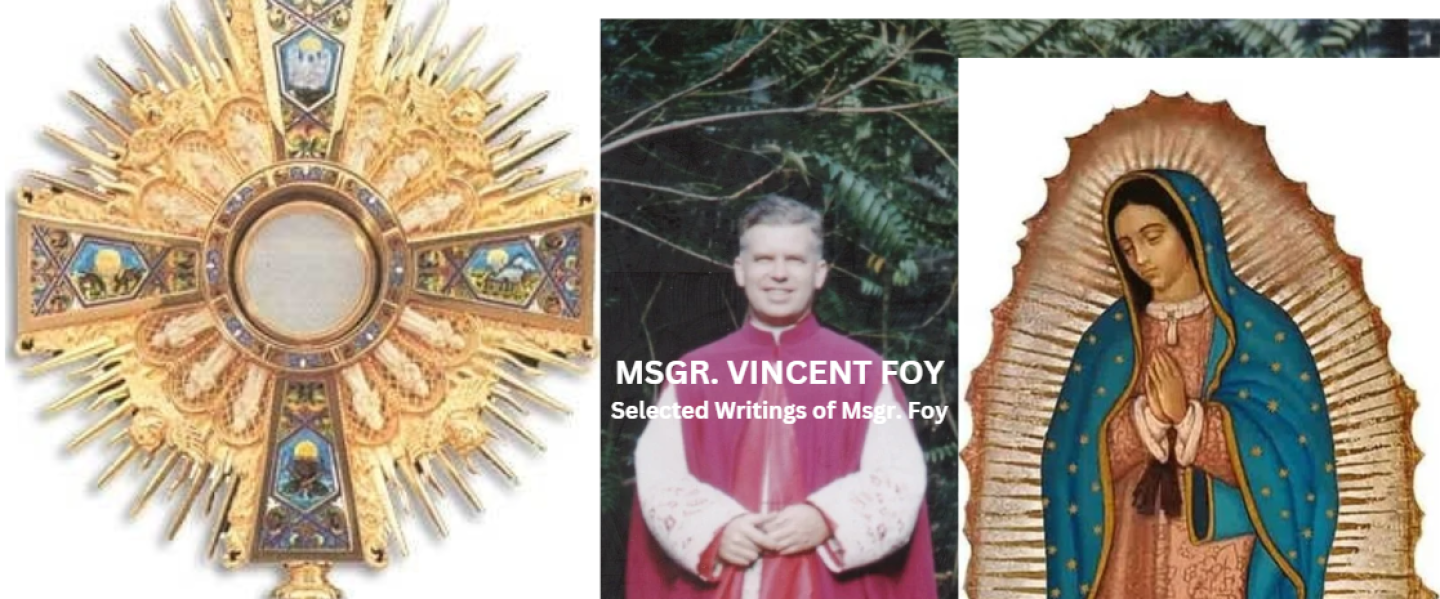
“People don’t touch their tongues to germ-ridden surfaces such as shopping carts, door handles, noses, toilet handles, soiled tissues, etc. Hands are often laden with bacteria. Those who distribute Holy Communion should carefully place the Host on the tongue without touching anyone. More germs can be circulated through Communion given on hands. The tongue can also be a steadier surface. Local bishops do not have the authority to ban Holy Communion on the tongue” (Rev. Msgr. Vincent Foy, April 28, 2015).
Mother Teresa of Calcutta: “It is the custom in our Society, and my known wish, that the Sisters receive Holy Communion on the tongue, which to my knowledge they are doing everywhere” (India, 1995).
“Our late great Holy Father John Paul II exemplified this reverence, often pushing himself to heroic sacrifices in kneeling before the Blessed Sacrament. Toward the end, when even this was impossible, he adored with his eyes and his heart.” (Zenit News ZE05082321, http://www.ewtn.com/library/liturgy/zlitur92.htm)
Worldwide Appeal:
- All clergy and laity are invited to ask and encourage the faithful to receive Holy Communion on the tongue and while kneeling; to come and kneel in a line or semi-circle in front of, along, and around the altar is the best proven and most efficient way, the common practice for centuries throughout the world.
- The use and restoration of an elevated step, mat or floor padding, pews or kneelers, communion rails, central Tabernacles, and the celebration of Mass facing the Lord with the congregation are suggested and encouraged where still needed.
Venite Adoremus!



You must be logged in to post a comment.