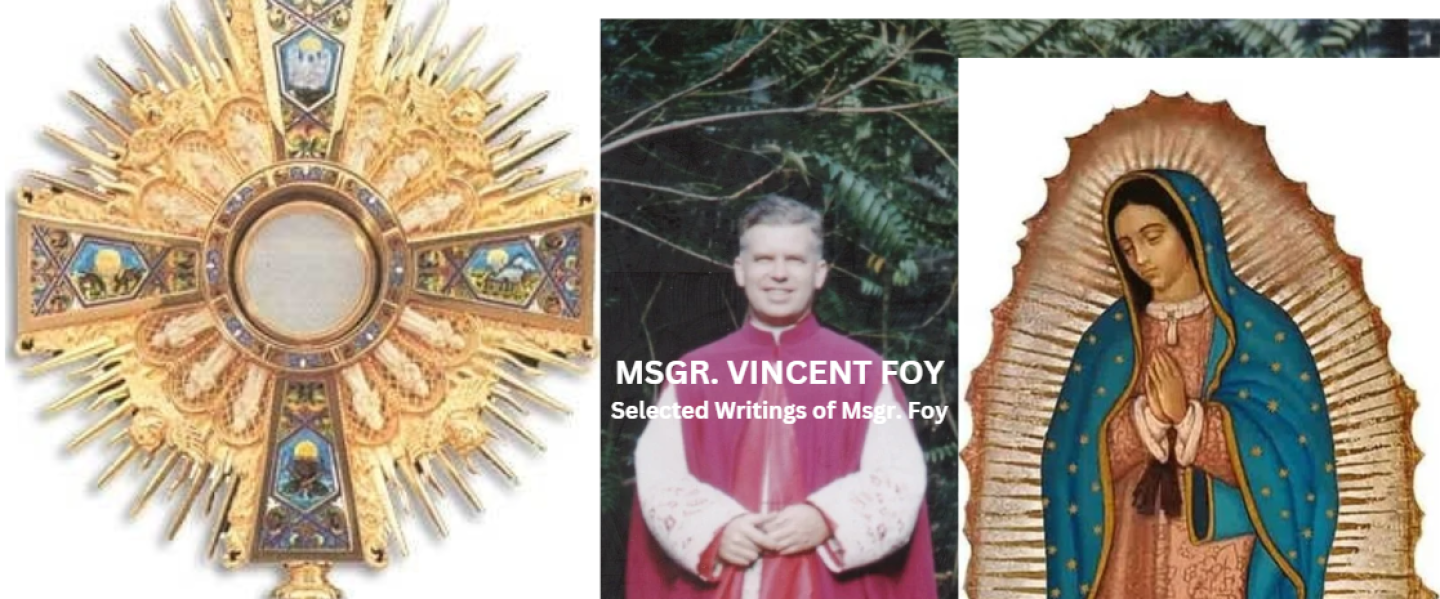
The Eucharist: “Do this for a Commemoration of Me.” – Luke 22:19

Sermon by Rev. Msgr. Vincent Nicholas Foy (August 14, 1915 – March 13, 2017) preached at St. Francis of Assisi church in Toronto on Holy Thursday, April 6, 1950

Part 1: Monuments to Men

Men, my dear brethren, when they wish some event or some person to be remembered, erect a monument to that event or that person. Our world and strewn with monuments, the attempt of the past to have itself remembered in the future. Notable monuments are the great pyramids and Sphinx of Egypt and the temples of Greece and Rome. In Paris is the famous tomb of Napoleon and the Triumphal Arch. In London is the tall column and statue in Trafalgar Square in honour of Nelson. Our own Canadian parks are dotted with statues to our Canadian heroes and statesman and our graveyards are filled with stones and crosses in memory of our dead.

Perhaps the greatest monument builders of all were the Mughals of India and the greatest of these was the Shah Jahan. He was a contemporary of Henry IV and Queen Elizabeth of England. In his own honour, he built the great Mughal Palace at Delhi, one of the most magnificent buildings in the world. John L. Stoddard, the great travel lecturer, tells us that no words are adequate to describe its sculpt and loveliness. In it there are literally miles of garlands, wreaths, vines, and flowers sculptured of precious stones. Its long corridors and rooms are paved, roofed, and lavished with purest marble. The tomb ordered built by Shah Jahan for himself was the famous “Peacock Theme,” one of the marvels of the world.

Jeweler’s labored for seven years in its construction and its value was no less than thirty million dollars. Then to entomb the body of his beloved wife, Shah Jahan had built, what is generally conceded to be the most perfect statue in the world, the Taj Mahal. It is the one completely faultless edifice that ever has reared. It was begun in the year 1630 and occupied 20,000 men for twenty years. It is a delicately sculptured mountain of Alabaster, supporting in its crest a sparkling dome. Into it were poured all the richest jewels and stones from the Mughal Treasury.

The writing of the history of Shah Jehan is this: on the walls of his great palace he had inscribed in exquisite mosaic a Persian verse whose meaning is “If there be a paradise on Earth, it is here.” Yet Shah Jahan was never permitted to occupy his palace; nor when the Taj Mahal was completed could he enter it to weep beside his beloved wife’s grave. His own son, the son of her who was entombed in the Taj Mahal, overthrew Shaw Jehan, and confined him to prison where he spent the last seven years of his embittered life.

So passes the glory of this world. And now, after over 300 years, incipient signs of corrosion are creeping into the great monuments of Shah Jahan.

Part 2: A monument to God

My dear brethren, the Mughal Palace at Delhi and the Taj Mahal at Agra are typical of most human monuments. No matter what their beauty nor what noble ends inspired them, they are dead things, built by man, and corruptible. They bear little or no relation to present life and very often they were built to satisfy a vanity that was defeated.

There is a monument and a memorial which bears none of these imperfections and the institution of which we celebrate today. This evening besides celebrating the anniversary of the truly great events in human history, we celebrate the institution of the greatest monument of all time.

Today, as you know, my dear brethren, many Catholics follow the laudable custom of making a visit to seven different churches to visit our lord in the Blessed Eucharist. And if we were to examine the history of this custom, we would find that it goes back to early Christian times when the Christians of Rome on Holy Thursday visited the seven principal churches of Rome. And what was the inspiration of this devotion? It was that on the first Holy Thursday, the eve of the day of our redemption by blood, there was given to the human race, the supreme monument and gift of God, Christ in the Eucharist.

Once more, in this anniversary we are naturally inclined to fix our attention on the solemn event of The Last Supper, which was also the first Eucharistic banquet.

Christ and his twelve Apostles are reclining at the Pascal table. Our Lord knows as He sits there that within a day every drop of blood will be drained from His veins. He knows that the soul of Judas is already blackened with the sin of selling for silver the Son of God; and that already it has been agreed upon that He should be betrayed by a kiss. Around Christ in the hearts of Judas, the High Priests, the scribes, and the pharisees the emotion of hate is welling stronger.

The atmosphere around Christ is heavy with hate. Yet here is the seeming contradiction. While men were planning the greatest act of hate Christ gave us the greatest gift of His love. At the very moment when the Jewish leaders were trying to remove Jesus from among the people, Our Lord instituted the means by which He would stay with them until the end of time.

So surrounded by hate, in Christ Himself at the Last Supper, there is only love. He says, “A new commandment I give unto you, that you love one another as I have loved you.” And then He says, “With desire I have desired to eat this Pasch with you, before I suffer.” And taking bread into His hands He says, “This is my Body” and taking wine, He says: “This is the chalice of My Blood,” and “Do this for a commemoration of Me.”

So it was that Christ made his last will and testament before he died, bequeathing to us the Supreme Memorial of the Eucharist – to stay with us until the end of time.

Part 3: The Eucharist is the greatest of all the sacraments.

Let us see how the Eucharist surpasses all human monuments to an infinite degree.

  1. The Eucharist is a memorial raised by God Himself. All others are the work of men.
  2. Human monuments are but imitations of the virginal or buildings of stone, wood, plaster, or metal, but the Eucharist is Christ Himself, in His Body, Blood, Soul and Divinity. The same Christ who walked and talked in Palestine nearly 2000 years ago. On our altar this evening is the same Christ who as a baby shivered in the manger at Bethlehem, who as a boy played in the streets of Nazareth and as a man raised Lazarus to life, healed Bartimeus the blind man, stilled the waves of the Sea of Galilee and healed the daughter of the Canaanite Woman.
  3. Human monuments are dead. But in the Eucharist, we have Christ our beloved living on our altar.
  4. Human monuments are corruptible. The nice smooth surface of the pyramids is worn away, exposing the great rough blocks of stone underneath and there are cracks in the Taj Mahal. The Eucharist is incorruptible. It will be renewed from the rising of the sun until the going down thereof, as prophesied in the Old Testament, until the end of time.
  5. Human monuments are built for the glory only of those for whom they are raised. The Eucharist was given us not only as a monument to Christ, but He instituted it also for us. It was instituted not to satisfy vanity, but charity. It is not something that bears no relation to our present lives, but something that can have a very powerful influence on our present lives and on our eternal happiness.

Part 4

My dear brethren, when Christ said, “Do this for a commemoration of Me,” what did He wish to recall to us; what did He wish to be commemorated by the monument of the Eucharist? To what is the Eucharist a memorial?

  1. First of all, the Eucharist is a memorial to the love of Christ for us and the love of God for us. When one person loves another, there is a desire to be near that other person. God so loved us that He gave us His only begotten Son, and this only begotten Son so loved us that He gave Himself to us, not only on the Cross, but in the Eucharist to remain with us in a spiritual way unto the consummation of the world. We do not need further proof of God’s love than His Presence in the Eucharist. His infinite condescension is beyond our understanding. All we know is that it is a reality, that God himself dwells with us in the Host as He dwelt with the Israelites in the desert in a cloud by day and the pillar of fire by night. He dwells with us to help us. He is, in the words of Fr. Le Buffe, “Our Changeless Friend.”
  2. Secondly, the Eucharist is a memorial to the passion of Christ. Christ present in the Host is a living monument to the history of our redemption by the Cross. As the prayer says which the priest recites in giving Communion outside of Mass: it recalls the memory of His Passion. It recalls Our Lord sorrowful unto death in the Garden of Gethsemane while His disciples slept. It recalls Christ our King standing before Pilate after a night of agony, with a reed His scepter, thorns piercing His flesh His crown and the soldiers coat His regal gown. It recalls the heavy lash weighted with lead which tore into His sacred body. It recalls the heavy Cross cutting into His shoulder on the way to Calvary. It recalls the sound of the hammers beating thick blunt nails into His hands and feet. It recalls the gall-soaked sponge being pushed into His mouth. It recalls the spear being thrust into His side and the last drop of His blood, the first payment for our sins, dropping to the ground of Calvary.

And when Jesus was hanging dead and bloodless on a criminal’s cross, they that passed by blasphemed and wagged their heads saying, “Vah, thou that destroyest the temple of God and in three days dost rebuild it: save thy own self. If thou be the Son of God come down from the Cross.”

“In like manner also the chief priests, with the scribes and ancients mocked Him saying if He be the king of Israel, let Him come down from the Cross: and we will believe Him.”

My dear brethren, Christ did come down from the Cross. He came down from the Cross to our tabernacles. Though we rejected Him through sin, He returns this rejection by love for us. No monument, no pyramid, no obelisk, no statue or carving or painting or sculpture erected by the might and intelligence of man can or could compare with the memorial we have on our altar.

Part 5

My brethren, what lessons, we may ask, are to be learned and what benefits are to be derived from the consideration of the Eucharist as a living memorial?

  1. Considering that Christ is present in the Eucharist as a memorial to His love for us, we have in the Eucharist Christ a sure friend to whom we should go too often in prayer. His special presence is a great help to our prayers. We know how much it helps our devotion in praying to the Blessed Virgin, or Saint Theresa, or Saint Anthony if we pray before a statue in their honour. It helps to realize their presence. In a still greater way, our devotion to Christ is aided when we realize that He is truly present in the Eucharist out of love for us. Waiting behind the Tabernacle veil for us to come to Him with our problems, our worries, and heartaches, waiting there to receive our homage and thanksgiving. Reflection on this should help us to realize the value of frequent visits to the Blessed Sacrament and frequent attendance at Benediction, Holy Hours, the Forty Hours’ devotion, and other devotions in his honour.
  2. Considering that Christ is present in the Eucharist and especially at Mass, as a reminder of His Passion for us, we should, as the Mass unfolds before us the sacrifice of the Cross in an unbloody manner, recall the sacrifice of blood on Calvary. If we follow the Mass with a Missal, we will be continually reminded of this. In our visits to the Blessed Sacrament, let the cross over the Tabernacle recall that the Eucharist is a monument to the Passion and death of Christ. Let the Eucharist give us the strong determination to see that in our individual case the Blood of Christ did not drip from the Cross of Calgary to the ground of Calvary in vain. Let it give us the resolution to spread the true conception, meaning and importance of the Redemption by blood to others: by prayer, mortification, and good example. In this way, my dear brethren, the purpose for which the great memorial of the Eucharist was instituted is fulfilled. In this way, the last Will and Testament of Christ made on the first Holy Thursday and later signed With His Blood is executed and we fulfil the words “Do this for a Commemoration of Me.”

—————————————————————————————————-

This handwritten sermon by + Msgr. Vincent Nicholas Foy, was typed for the first time on Ash Wednesday, March 5, 2025  by Staff of PERPETUAL EUCHARISTIC ADORATION www.perpetualeucharisticadoration.com

Msgr. Foy’s handwritten notes can be viewed on his website MSGR. VINCENT FOY – Selected Writings of Msgr. Vincent Nicholas Foy at this link:  https://msgrfoy.ca/wp-content/uploads/2025/04/holy-thursday-sermon-1950-msgr-foy.pdf

This article was published on Catholic Insight HERE on April 17, 2025.

After a long day working at the chancery offices, Msgr. Foy would travel far to be the guest preacher at Forty Hour devotions with exposition at parishes. He was a co-founder and director of a charity, which assists parishes with expanding Eucharistic and perpetual adoration.

Msgr. Foy is known as the longest ordained and oldest diocesan priest in the history of the Archdiocese of Toronto and the longest ordained Anglophone diocesan priest in the history of Canada. Worldwide, four served longer.

PDF – printable copy of this sermon

The Eucharist: Best of the Past and the Future

Sermon by Rev. Msgr. Vincent Nicholas Foy preached at the evening Mass on Sunday, February 12, 1956

The Eucharist Is the Best of the Past and the Best of the Future

If we were told – we here this evening – that we could have in our possession now, the best of the past and the best of the future, would we not think such a statement incredible?

What can we call out of the past that we could call the best? Would it be happy days of childhood, days of laughter … days of youth and health and strength? Or perhaps we might think the best of the past to be all that man has mined and discovered and invented and produced: we might think of gold, money, the best of homes, the best of clothes, food, medicine, cars and televisions and all the goods which man in the past has brought to reality with his mind and hands and imagination.

And what can we predict for the future which is the best? We might think of peace, of universal government, of larger lives and better health; we might think of the fruits of atomic energy, the 1000 wonders yet to be evolved from electronic research, the wonders of Medicine to come, the benefits to be eventually derived from the conquest of outer space and other planets.

Thinking along these lines, it would seem incredible that we can possess now the best of the past and the best of the future. This is perhaps because we, living in a world of breadth and length and thickness, so often think along the immaterial grooves to which flesh has chained us.

One of the great theologians of our day, Fr. Garrigou-Lagrange, has made the almost incredible statement that we can possess now the best of the past and the best of the future. His explanation is simple, but as true as truth itself. He tells us: “In the Blessed Eucharist we possess the best of the past and the best of the future.”

The Best of the Past

After all, in the order of absolute reality, is not the best of the past our redemption by Christ on the Cross – the purification of our souls by the blood of the Son of God?

The Blessed Eucharist is not a reminder of our redemption in the way a crucifix in our homes or in our churches is a reminder. Nor is it a symbol of our redemption, the way the crown of thorns, the beggar’s cloak, the reed, the heavy lash, the hammer, nails, and the vinegar-soaked sponge are symbols. These are but figures recalling the long ago.

In the Eucharist, in the Sacrifice of the Mass, we believe is the re-enactment of our redemption as it took place on Calvary: the same High Priest and the same Victim. Only the manner of offering is different. This we learned long ago. In the Catechism the question is asked: “Is the Mass a different sacrifice from that of the Cross?” And the answer is: “No; because the same Christ who once offered Himself as bleeding Victim to His heavenly Father on the Cross, continues to offer Himself in an unbloody manner by the hands of His priests on our altars.”

All of the great … of the death of Christ for us is memorialized and re-enacted in an unbloody manner in the Sacrifice of the Mass, in keeping with the Divine Command: “Do this for a commemoration of Me.”

And what next of the redemption is the best of the past? Is it not the Presence of God with us? God has always shown His love by the company of man. When He formed man after His own image; so God spoke to Adam in Eden; He appeared to His prophets and Saints. So when the Jewish people were wandering in the desert God stayed with them in the form of a cloud by day and a pillar of fire by night.

And has not God continued to keep us company?

When Christ was hanging white and bloodless on the Cross the cry came: “If thou be the Son of Man, come down from the Cross.” Christ has come down from the Cross into our tabernacles. Out of love for us Christ has watched and waited on all the altars and in all the Tabernacles throughout the centuries even as He rests on the altar of this church tonight: to be adored, to be thanked and to help us and grant the graces which all of us sorely need.

And what has been the best of the past for us as individuals? If we had the spiritual vision of our angel, the vision that strips away all that is transitory, all vanity and folly, would we not see in our past Holy Communions the best of the past? There was the day of our First Holy Communion, which many of us regard as the happiest of our lives, when we went with folded hands and white souls to meet Christ face to face at the Communion table and to become one with Him. There were all the other Communions when perhaps with souls washed by the Blood of our Saviour in Confession, we approached our God in Holy Communion and felt the joy of His Presence in our souls.

There dear friends were the best of the past, our redemption, the Masses since said, the Presence of God in our midst, and all the past worthy Holy Communions: in a word – the Eucharist.

It is the Best of the Future

Fr. Garrigou-Lagrange tells us that the Eucharist is also the best of the future.

How can this be? What is the best of the future?

Looking at the future as it should be looked at, through the eyes of God, with the vision we will look at when we stand facing God to be judged, is not the best of the future the acts of charity which we shall perform and the degree of charity to which we shall attain? Besides this all else is secondary.

God gave of all the best to His Blessed Mother: yet He did not give her riches, He did not give her material wealth, a fine home, the latest fruits of medicine in progress. Yet God gave her the best: the greatest degree of charity ever possessed by a creature, a great love that embraces all her spiritual children.

My dear brethren, the royal road to charity is through the Eucharist and especially Holy Communion. Through Holy Communion we are united to Christ in a bond of love, more closely than two pieces of wax which when melted became one. Through Holy Communion we are united by a bond of charity to all those who have partaken and do partake and shall partake of the same Bread: to the Apostles, the Martyrs, the Saints and to all others, from the highest to the lowest sons of God. In Holy Communion we are given a special sacramental grace – the grace to grow in love of God and others, the grace to make our impulses to charity operative, the grace to grow in beauty and strength of soul before God.

No wonder Pope Pius X, now St. Pius X had frequently to say: “Beloved children, the surest, easiest, shortest way to Heaven is by the Holy Eucharist.”

In another way the Eucharist is the best of the future. In the prayer which the priest says in giving Holy Communion outside of mass occurred the words: “Oh Sacred Banquet, in which Christ is consumed, in which is recalled the memory of His passion and in which there is given to us a pledge of our future glory.” So Holy Communion is a pledge, an earnest, a sign of our future glory in Heaven. Christ made it such. When He was foretelling the institution of the Eucharist, He recalled that during the forty years in which the Jewish people were in the desert after they had escaped from Egypt, God sent them a food called Manna which tasted like bread and honey.

“And yet” said Christ, “although your Fathers ate of this food from God, they are dead. But whosoever shall eat of the Food that I will give shall live forever.”

Surely in Holy Communion, the royal road to charity and the pledge of eternal life, is contained the best of the future.

The Lesson for us Here and Now

My dear brethren, what do the truths which we have been considering mean to each of us here present?

Are we going to always continue as we perhaps have, without minding the words of Christ: “Be ye perfect as my heavenly Father is perfect.” Shall we who are here this evening travel down all the byways of life, chasing butterflies as it were, the roads of vanity and folly, blind roads where money and pleasure beckons: roads not of sin, perhaps, but roads which twist and turn and lead us nowhere, roads turning us aside from the one straight true and only important road – the road to charity and to God?

Next Wednesday we are reminded of the folly of following all the byways and side roads of life. The Ashes will be placed on our foreheads and once again we will hear the familiar words: “Remember that thou art dust and unto dust thou shalt return.” These are the words which there at our graveside side we will also hear. They recall the words of Christ of heavenly wisdom: “Lay not up to yourselves treasures on earth: where the rust and moth consume and where thieves break through and steal. But lay up to yourselves treasures in heaven: where neither the rust nor moth doth consume and where thieves do not break through and steal.”

Let us realize, my dear brethren that in the Eucharist, in the Mass, in the true Presence and in Holy Communion, we have the fountainhead of all grace, the greatest of the Sacraments. Through the Eucharist, and by the hands of the priest, grace is channelled from the wounds of Christ into our souls. And, that Grace, that love of God, that love of other is the treasure that cannot rust nor be consumed, nor stolen by thieves.

As St Paul says: “Who then shall separate us from the love of Christ? Shall tribulation? Or distress? Or famine? Or nakedness? Or danger? Or persecution? Or the world?

In all these things we overcome, because of Him that hath loved us.

For I am sure that neither death, nor life, nor Angels, nor principalities, nor powers, nor things present, nor things to come, nor might, nor height, nor depth, nor any other creature, shall be able to separate us from the love of God which is in Christ Jesus our Lord.”

We here, my dear brethren, can make no better resolution for this coming Lent than to make Lent a Eucharistic Lent.

How can we do this?

  1. We can make it a Eucharistic Lent by attendance at daily Mass, if possible; or if that is not possible by attendance at Mass on some days as well as on Sundays and by greater devotion at Mass.
  2. We can make it a Eucharistic Lent by visits to Christ present in the Tabernacle.
  3. We can make it a Eucharistic Lent by attending Lenten devotions, where we receive Christ’s blessing at Benediction.
  4. We can make it a Eucharistic Lent by more frequent reception of Holy Communion with better preparation and thanksgiving.

And having visited Christ and assisted at His offering on the Altar for us, and having partaken of His Body and Blood worthily, we partake of all that is best in this world. We should go back into our homes, our offices, our factory, our store, our workshop, and mingle with other relatives and friends with a greater peace, a true joy, a stronger love of them and love of God.

—————————————————————————————————-

The above handwritten sermon by + Msgr. Vincent Nicholas Foy, was typed for the first time on Shrove Tuesday, March 4, 2025  by EUCHARISTIC ADORATION – www.perpetualeucharisticadoration.com

His handwritten notes can be viewed at this link:  https://msgrfoy.ca/wp-content/uploads/2025/03/the-eucharist-msgr-foy.pdf 

This article was submitted and published on Catholic Insight HERE on March 4, 2025 and shared on March 13, 2025 on Msgr. Foy’s website as a memorial of his passing on March 13, 2017.

One can imagine Msgr. Foy preaching this sermon with his great love, devotion to and faith in the Eucharist. After a long day working at the Chancery, he would travel far to be the guest preacher at Forty Hour devotions with exposition at parishes.

Msgr. Foy was a great supporter of perpetual adoration and exposition of the Blessed Sacrament, which have grown much since he preached this sermon in 1956. He was a co-founder and director of our registered charity, which promotes and assists parishes to establish and expand Eucharistic and perpetual adoration. We praise God for Msgr. Foy’s loving and wise spiritual and practical direction, mentorship, and assistance. www.perpetualeucharisticadoration.com

PDF – Printable copy of this sermon

The Prayers Before the Consecration of the Eucharist

Sermon by Rev. Msgr. Vincent Nicholas Foy preached at the evening Mass on Sunday, December 6, 1959 at St. Michael’s Cathedral, Toronto

This evening, my dear brethren, we are going to consider briefly and, as it were, in a passing way, that part of the Mass which prepares us for the Consecration, which is the great centre, heart and essence of the Sacrifice of the Mass. This preparatory part of the Mass extends from the Preface to the last short prayer before the Consecration. This section of the Mass is also called the first part of the Canon of the Mass.

Perhaps it will help us to know what is meant by the Canon of the Mass. The Canon comprises the prayers at Mass from the Preface to the Pater Noster – Our Father. The word Canon means a rule or fixed measure and consists of parts of the Mass which, with slight exception, do not change but are the same for every Mass. It is interesting to reflect that in the beginning it was just the opposite. In the earliest Church the bishop or priest himself provided fitting prayers to surround the Consecration.  St. Justin Martyr, wrote in the second century: “He who presides offers Eucharistic prayers and thanksgiving according to his ability.”  Later, for the sake of uniformity and to ensure that these prayers were the most fitting possible, the Church determined and set the wording of the two beautiful and appropriate prayers surrounding the Consecration. These we call the Canon or fixed prayers and as we have them today, they go back at least to the fifth century.

The Canon begins with the Preface. The Preface sources the theme of the whole Eucharistic Sacrifice, which is one of thanksgiving. How fitting that we should be thankful for the coming of Christ:

  1. firstly into the world to save us
  2. secondly onto our Altar to unite us and apply the fruits of Calvary and
  3. thirdly into our hearts through Holy Communion to unite Himself with us and to sanctify us.

So we give thanks in the preface and the priest begins this prayer with the words “Lift up your hearts.”  Surely, we have reasons enough at Mass to lift up our hearts, above our worries and ever grievous sufferings in the knowledge that Christ; Who can take care of us and them, and has taken our sins on His shoulders is coming down upon our Altar and into our hearts and souls. The priest continues: “Let us give thanks” and then “We should at all times and in all places give thanks to Thee, O holy Lord, Father Almighty.” The preface has been called worthy of a choir of angels. It ends with that beautiful prayer, the “Sanctus” one of the most ancient in the Church mentioned by St. Clement of Rome who died in the year 104.

In the Sanctus thanksgiving blends into praise; “Holy, Holy, Holy, Lord God of Celestial Hosts, Heaven and earth are full of Thy glory.”

Part 2: From the “Te Igitur” to the “Quam Oblationem”

All of the prayers that follow the Preface up to the Consecration refer to the Act of Sacrifice to take place. By the time the Sanctus bell has stopped ringing the priest is saying the Te Igitur or Prayer for the Church. The priest invokes the fruits of the Mass in the Church, the Spouse of Christ, in the pope and the bishop, who are mentioned by name. This petition recalls the prayers of Christ for His disciples at the Last Supper.

Then comes the “Memento Domine” or Memento for the Living. During the prayer the priest folds his hands and mentally recalls those of the living to whom he wishes to apply the Holy Sacrifice. The faithful should also recall their intentions at this time. Why not here remember living benefactors, relatives, or the sick or dying, or the suffering, or the mentally ill for the pagan or godless world? The priest prays here also for all those present. The faithful too should pray for their companions present in the church whose lives have converged, met and then go their separate ways – we pray in grace.

The next prayer is the Commemoration of the Saints. The prayers of the priest and people are here united with those of the souls in glory. First in the list comes Mary, “Mother of Our God and Lord Jesus Christ.” Then come the names of the twelve Apostles and twelve martyrs, an account of their lives spreads over the first four-hundred years of the Church’s existence. It is consoling to be privileged to unite our prayers with theirs.

After the Commemoration of the Saints is the “Hanc Igitur” or Preparation for the Consecration. During this prayer the priest places his hands over the bread and wine and the bell rings to remind us that the Consecration is at hand. In the Sacrifice of Atonement in the Old Law, the high priest placed his hands upon the head of the animal before it was slain to indicate that the sins of the people had been transferred to the victim of sacrifice. In the Mass the priest, and through him the people, virtually touch the sacrifices and in a symbolic manner transfer their sins to the elements which are to become the Body and Blood of Our Lord Jesus Christ, the scapegoat for our offenses.

There is another very brief prayer before the Consecration called the “Quam Oblationum” in which the bread and wine are given a final and special blessing.

Such are the prayers in preparation for that great moment of the Consecration when the Altar again becomes the table of the Last Supper. The priest stands in the place of Christ and the self-same words which Christ uttered are again pronounced in another tongue but with the same effect: bread and wine become the Living Christ.

May I suggest, my dear brethren, that we who are privileged to return through the Mass to the Last Supper and to Calvary continually study the Mass, assist at it with greater attention and devotion and participate in it more closely united with the priest and other members of the congregation – remembering that we are all one in Christ our Saviour.

Amen.

This handwritten sermon by + Msgr. Vincent Nicholas Foy, was typed for the first time on the Feast of St. Nicholas, December 6, 2024  by EUCHARISTIC ADORATION – www.perpetualeucharisticadoration.com

Also published on January 10, 2025 at https://catholicinsight.com/prayers-before-the-conscecration-of-the-eucharist/

Handwritten notes of Msgr. Foy – pdf