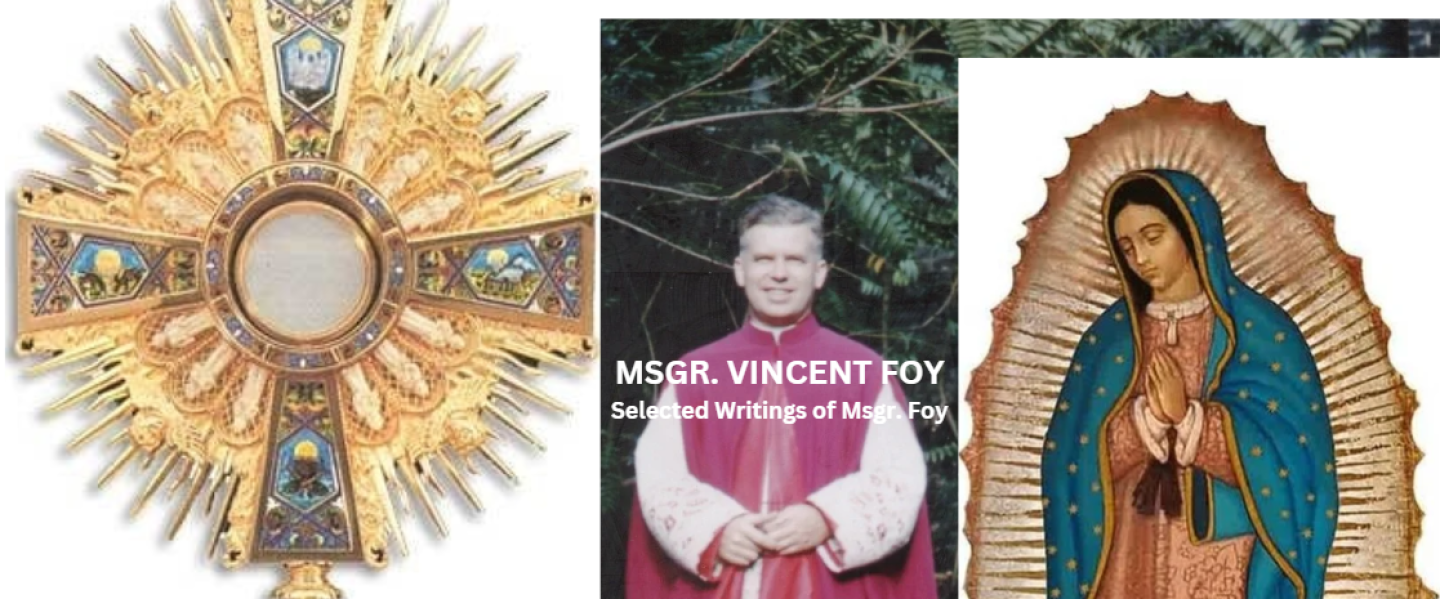
Curator of the Museum. By Monsignor Vincent Foy

Curator of the Museum

By Monsignor Vincent Foy

It was September 1934. We who had entered St. Augustine’s Seminary in 1933 had the joy and privilege of going into our second year of Philosophy. Our text was in Latin by Lortie, professor of Philosophy at Laval in Quebec City. Years later I was to discover his grave in the crypt of the old chapel at the entrance to the Quebec seminary.

Out of twenty-one students in first year Philosophy for Toronto Archdiocese, twenty returned in 1934. Missing was Joe Cartan, whose blood uncle was my uncle by marriage. He was married in 1938 on the same day most of the rest of us became Deacons. He would go on to become General Manager of Massey Hall. Jack Myers came into the seminary from St. Michael’s College in September 1934, so we were still twenty-one for Toronto.

We in second year Philosophy went as it were from the bottom to the top. The seminary was so full in 1932-33, with some students doubling up, that in the summer of 1933 rooms were hastily built in the basement of the main building. We referred to them as “the Catacombs”. Now we found ourselves at the top of the annex called “Kehoe Hall” after our beloved Spiritual Director Fr. Kehoe. My room in Kehoe Hall was number 159 on the top or fourth floor.

On the bulletin board upon our return were the names of seminarians appointed to special tasks, e.g. Head Prefect, the other Prefects, sacristans, master of ceremonies etc. I was named to the lofty position of Curator of the Museum.

The museum, long since gone, was at the south end of the main corridor on the ground floor. It contained numerous glass cases with interesting items from many countries, mostly from the Holy Land. The museum was also the Reading Room. There we were allowed to read Catholic newspapers and periodicals in our free time on Thursdays or Sundays. We were not allowed to receive secular newspapers or have a radio in our rooms. Until Archbishop McGuigan came in 1935 the front and sporting pages of the Toronto Globe and The Mail and Empire were posted on the bulletin board after lunch, in the corridor leading to the Annex. That was stopped when Archbishop McGuigan first came to talk to us in the chapel. He told us we were “the apple of his eye”. He also said that anyone found with a newspaper in his room would be “peremptorily expelled”.

My position as Curator of the Museum was not all honour and glory. I was to dust it and clean it and keep it in good general shape during my recreation time. I also had to knock on the President’s door every Thursday and Sunday mornings to get an armful of Catholic reading to be temporarily put in the Reading Room, and return them later. This was to me a rather fearful experience. The President, Msgr. Francis P. Carroll, later Bishop of Calgary, was not always pleased with my intrusions. Sometimes he would say “Can’t you see I’m busy. Come back later.” Or in a voice from his inner room would shout out “Later! Later!” Once I was put out three times and did not go back. After lunch I was given a rather severe reprimand for not doing so.

All went well until the spring of 1935. It was announced that we were to have an Apostolic Visitation by the Apostolic Delegate, Archbishop Cassulo. I was called in and told that the museum had to be in better shape. Among other things I was told that every label, and there were many, had to be replaced. They were getting yellow with age. I was given the rare privilege of staying inside the building during the main recreation period of 4:00 to 5:30pm to carry out renovations.

Let me digress. Another interesting preparation was for the possible entrance of the Delegate during one of our lectures. Although most texts were in Latin, the lectures were in English. Our professors were simply unable to speak Latin like those in Montreal and Quebec City. So Father Ingolsby, who taught philosophy, practiced one lecture in Latin and we were given a few Latin questions to ask. Thankfully the classroom visit did not come, at least to us.

Archbishop Cassulo, later Delegate to Hungary where he was once stoned by communists, did make a thorough investigation of all the seminary facilities. He visited many student rooms and later reported a number of repairs to be made.

The rule that one could not stay in one’s room during the main recreation period was a strict one! We were supposed to be out playing handball or other sports or climbing the Scarboro Bluffs on the property or walking in pairs or groups. Walking alone was prohibited, as I found out during my first week in the seminary.

It happened that after my diligent work in the museum I was quite exhausted. For the first and last time in my six years in the seminary, I took to my bed during the main recreation period. I thought I was safe on the fourth or top floor of Kehoe Hall.

Happily in bed, at about 4:30 pm I heard footsteps on the stairs and then voices. One of them was the very recognizable voice of Msgr. Carroll. The other heavily accented voice I knew must be that of the Delegate. I was quite terrified. My room was just opposite the top of the stairs. I heard them go into the room next to mine on one side, and then go into the room next to mine on the other side. When I heard them going down the stairs I said a silent prayer of thanksgiving.

If Msgr. Carroll had opened the door of room 159 and found me cowering under the sheets, I wonder whether I would be writing this today?

Personal Memories of Msgr. Vincent Foy: “The Toronto Archdiocesan Blue Laws”

By Rev. Msgr.Vincent Foy

The Toronto Archdiocesan Blue Laws

As a young priest, ordained in 1939, I had some experience of what it was like to live under the so-called Blue Laws of Toronto Archdiocese. I don’t think the great majority of us considered them a heavy burden. In general I think the morale of the clergy was higher than it is today.

The Blue Laws had their origin in about three incidents, which took place in the spring of 1937. Two priests, one diocesan and one religious, were arrested for driving under the influence of alcohol. One of these charges involved the death of a pedestrian. Another priest was charged with immoral behaviour with a nurse in a parked car. The anti-Catholic Toronto press carried reports of these events in headlines. When the public was excluded from the trial of the priest charged with immoral behaviour, the headline in the Toronto Evening Telegram was: “Why is priest case held in camera?”

At the time, since we saw no newspapers, news of these sad events filtered only gradually to us seminarians at St. Augustine’s Seminary. We learned that Archbishop McGuigan was away during at least two of these incidents and when he returned he was greatly shaken. First he called a meeting at the Seminary of all curates. I recall that when I was returning to my room after the afternoon recreation I could hear his raised voice coming from the spiritual lecture room, where he was talking to the priests. He could be heard, I think, anywhere in the building. I remember his words: “If you can’t live your commitment to chastity, rip off your collar and get out”.

The following week he called all pastors to the Seminary and lectured them, but in a much more subdued tone.

Following this, on July 6th, 1937, Archbishop McGuigan sent a letter to all priests. It was entitled “Regulations for the Clergy of the Archdiocese of Toronto. The subheading was “Serva Regulam et Regula Servabit Te”. This letter contained the famous or infamous Toronto Blue Laws. Here are the principal parts:

1. All priests were to be in the parish rectory not later than 11P.M.. When a curate foresaw that he would be later for a good reason, he was to inform and obtain permission from the pastor before leaving the rectory. If detained for some unforeseen reason, he must report to the pastor or rector on his return.
2. Social visiting in parish homes was altogether discouraged.
3. No priest may purchase a car without permission of the Archbishop. Permission would be denied when there is no real need or when the priest could not afford to pay for or operate a car without incurring debt.
4. Absolutely, and “sub gravi” it was forbidden to any member of the clergy, Diocesan or Religious or peregrini to:
(a) operate a motor vehicle within eight hours after having drunk any quantity, no matter how small, of any intoxicating liquor, including beer and wine (except the wine actually used during the celebration of the Divine Sacrifice of the Mass).
(b) enter, be in , ride in or operate a motor vehicle in which there is present a member of the female sex, exception made only for the mother of the priest

Both these laws, binding “sub gravi”, carried with them the censure latae sententiae of suspension a divinis et suspensione a jurisdictione, each incurred ipso facto and each reserved to the Ordinary of the Diocese.

5. Drinking with the laity or in the homes of the faithful was altogether prohibited.

It should be added that all seminarians destined to serve in Toronto Archdiocese, upon ordination to the diaconate, were required to take the pledge to abstain from all alcoholic beverages for a period of ten years. I recall that our class took the pledge one by one in the seminary chapel. Under the supervision of Dr. Davis each of us placed his hand on the bible in the sanctuary to make this solemn commitment.

Such was the situation when I was ordained on June 3rd, 1939.

What a great tragedy it would be to be suspended on one’s day of ordination. Yet in the objective order, on my ordination day, I committed an act which merited suspension according to the Blue Laws. It was the custom in Holy Name parish, to which I belonged, for the newly ordained priest to stay at the parish rectory the night before his first Solemn High Mass. Msgr. Cline, the pastor, called the visitor’s room, on the third floor, Patmos. So I had the privilege of sleeping one night in Patmos. I had spent the afternoon and early evening after ordination at home on Fulton Ave. About 8 P.M. my brother Edward drove me to the rectory. It was just after the car stopped that I realised that my little sister. Shirley, then ten years old, was sitting in the back seat. So I was saved from suspension by my inadvertence.

By a letter dated June 20th, 1939, I was appointed to serve as a curate to the Dean of St. Catherine’s. I was sent a copy of the 1937 Regulations, which I still have. I was also reminded that I was to be in the rectory by 11 P.M., and that social visiting was absolutely forbidden. I was also told: “ The spirit of serious reading and study should be fostered, great zeal shown in the work of parish visiting and reclaiming lapsed Catholics, also in any other specific work given you by your Pastor”.

Something of a ridiculous situation arose when I was stationed in St. Catherine’s in the summer of 1939. I was walking back to the Deanery from the General Hospital when Ed Sheehan of St. Mary’s parish stopped to give me a drive. When I opened the front door of the car I saw a baby on the front seat. I said: “ Ed, is this a boy or a girl?”. He told me it was little Mary (I am not sure of the name, but I know that later she became a Sister of St. Joseph). I said, “Many thanks, Ed, but I need the exercise”. I gave no explanation. Msgr. Cline told me he once ordered a little girl out of the rumble seat of a car when he was offered a drive home. She went crying into her house. He was too ashamed to give a reason.

The wording of the Blue Laws was not quite canonical. It forbade driving with a member of the opposite sex instead of person of the opposite sex. This gave rise to a number of humorous comments. Msgr. Cline said that if a queen bee flew into his car he would have to stop it and get out.

Various interpretations were given to the prohibition against driving after consuming an alcoholic beverage. One was that both actions, driving and drinking, had to take place within Toronto Archdiocese. According to some it was licit in driving back from the Niagara Peninsula, then in Toronto Archdiocese, to stop over for a meal and drink in Hamilton and then proceed to Toronto. A very few claimed that the Blue Laws were invalid and a very, very few ignored them, but the old code of canon law stated that a bishop’s doubtful penalty had to be obeyed until the matter was settled by the Holy See.

Only once did I suffer the consequences of violating the Blue Laws. While a curate under Dean Cullinane of St. Catherine’s, I arrived at the Deanery shortly after 11P.M.. I had been over to Niagara Falls, New York, and my driver underestimated the time it would take to get back. The door was locked and barred. After I had alerted him by throwing coins at his window, the senior curate, Fr. Austin Sweeney, kindly came down and let me in.

The regulations in Toronto sixty-five years ago are now considered overly restrictive, but they were not as severe as were rules in Quebec province at that time. When I went to study Canon Law at Laval University in Quebec City in the fall of 1939, regulations were much stricter. No curate could have a phone in his room, or own a car. In parish visiting one was expected to stand at the door except for sick calls. It was obligatory for a priest to wear the soutane outside at all times, even when riding a bicycle or skiing or skating. Priests were forbidden to attend movie theatres or even professional hockey games. We were allowed to attend classical musical concerts at the Palais Montcalm. Yet in Quebec also, the morale of the clergy was high, and there was always much laughter and good conversation and solid piety at the Maison des Etudiants, where I lived.

All in all perhaps the Toronto Blue Laws were not so Blue after all.

_________________________________________________________________________________________________________________

This article was originally published in Emeritus.