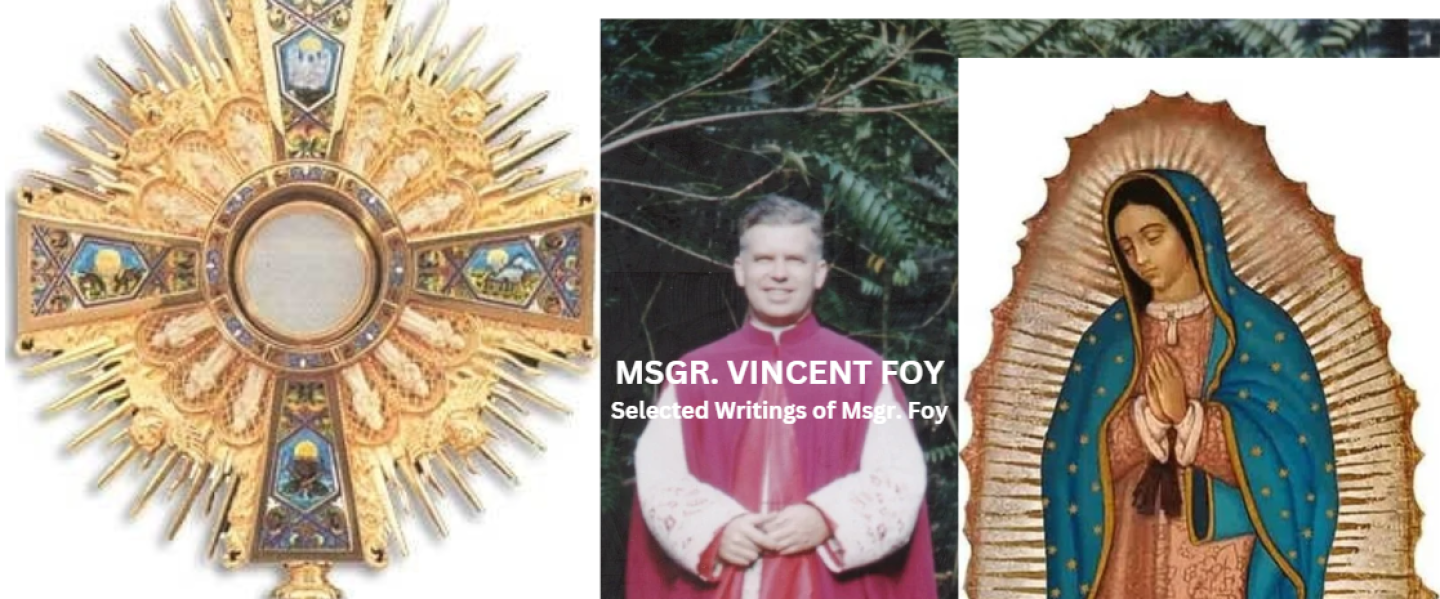

The following article was originally published in Emeritus, Volume 1, Issue 6.
A Vocation Almost Lost
By Monsignor Vincent Foy
Every priest walks a unique path to the altar. Some vocations come late, others early. Here I briefly recount my own providential journey, for which I am eternally grateful.
My hope of becoming a priest began when I was eight years old, in December of 1923. It was on December 22nd of that year, in St. Michael’s Hospital, that my mother gave birth to my sister Doreen, now a retired nurse. Soon after my mother, then 38 years old, grew gravely ill with double pneumonia, and was not expected to live. There were no antibiotics in those days.
As though it were yesterday, I recall our father gathering together my older brother Edward, my younger brother Jack and me, in our parlor. The doctor had told him that it would be most unlikely that mother would last the night and that the children should be prepared. Our father told us that mother was very sick and God might be calling her to heaven and we should be brave.
Shortly afterwards I went into the dining-room, separated from the parlor by sliding doors, and paced up and down, tears streaming down my face. I promised God that if mother lived I would do my best to become a priest. That is not the best way to choose a vocation, but that is the way it was with me.
Remarkably, my mother passed the crisis and next day was considerably better. From that day I never wavered in my hope and resolve. I never told my mother or anyone of my promise. Incidentally, while mother was in hospital, her younger sister, Anna, also in St.Michael’s, died of pneumonia after giving birth to my cousin Barbara. Mother was not told of this until some time after.
It was in 1926 that Fr. James Fullerton, then a curate under Father Cline at Holy Name parish, entered our Junior Fourth classroom and asked my close friend Billy McGuire and me to step into the hall. He told us we were to be altar-severs and would join a group of younger boys the following week to begin learning the Latin and ceremonies. Soon after he dropped into our home at 40 Fulton Ave., and told my mother in my absence that I was to give a talk at the next meeting of the Junior Holy Name Society. The subject was to be: “The Duties of a Priest”. That would be my first speech.
Throughout high-school I was encouraged in what I believed was my vocation by Father Cline, Fr. Fullerton, who would preach at my first Mass and my Silver Jubilee Mass, Fr. Hodgins, and Fr. Fred McGinn – all great role-models.
In September of 1933, just turned eighteen, I entered St. Augustine’s Seminary. No Xray or doctor’s report was required. Shortly after the Fall retreat, the newcomers lined up on a Thursday morning for a medical check-up. I was behind Albert Goetz from Hamilton. We talked about age and Albert said: “I will never see a quarter of a century again”. I thought to myself: “They are taking in old men now”. Conducting the examination was Dr. Brown, the seminary physician, in the presence of Dr. Davis, the Prefect of Discipline. Dr. Brown had been my mother’s doctor when I was born and had brought me into the world at home in 1915. The exam took about one minute. Dr. Brown listened to my heart, thumped me a couple of times on the abdomen and declared me fit.
For the first two years in the seminary my health was good and I took part with exuberance in all the sports: touch football, golfing on the “flats”, handball, hockey, bowling in the gym, and cliff-climbing. Because I had one weak eye and did not have three-dimensional vision I was always on the “bizz-cat” teams reserved for the poorer players.
Joining our class in September 1934 was Jack Myers. He had been to St. Michael’s College for a year after High School and so was admitted into second year philosophy. We were related. His mother was Kathleen Foy, daughter of George Foy, the wealthy liquor importer, younger brother of Nicholas Foy, my grandfather. All during the 1934-1935 year, Jack sat opposite me in the refectory.
Jack Myers was a fine-looking, polite and always good-humored young man, though quite frail. During the year he had several facial boils, which I was told later were sometimes a sign of early tuberculosis. In any event, during the summer of 1935, he was admitted with tuberculosis to Mountain San in Hamilton, where he spent the next two years; he was unable to return to the seminary. We kept in touch until his death about ten years ago.
In the Fall of 1935 my health deteriorated rapidly. I did not suspect it then, but learned much later that it was my own first bout with tuberculosis. I thought it must be the strain of the rather exacting seminary discipline. Studies were more difficult and my marks took a dip. I was no longer able to enjoy the sports. I remember dragging myself around the chapel dusting the pews when I was on Thursday morning “sacristy duty”. My weight dropped from 150 to 140 lbs. Shortly before our Christmas break of 1935, Msgr. Carroll, the President, called me aside in the corridor. He said “You are not looking well at all. I am afraid that if you do not pick up we may have to send you home”. To me that was like a stab in the heart, yet I knew I could not continue the way I was.
Shortly after, just before our fifteen-day Christmas break, I packed everything I owned into my trunk and labeled it with my home address of 40 Fulton Ave., Toronto. It was my firm intention to have the trunk sent me during the holiday season and write a letter to Msgr. Carroll saying that my health would not permit me to return.
By God’s merciful will, I felt considerably better during the Christmas break, resting much and eating well. I decided to give the seminary one more try.
Early in January of 1936 I discovered a book which I believe saved my vocation. In those days students were not allowed to visit the reference library on the top floor without the written permission of a professor. We did have a list of books, mostly lives of saints and other spiritual books, available in the students’ library, which was at the north end of the main corridor. We were not permitted to enter it, but the librarian, that year Bill Capron of Ogdensburg, was at the door for a short time on Thursday evenings and would give us the book or books requested. The book that attracted me was entitled “My Water Cure” by Father Sebastian Kneipp, a Bavarian priest. This book was first published in 1886, and became a world-wide best seller.
Father Kneipp, later Msgr. Kneipp, was a pioneer in hydrotherapy. As a young man he wanted to become a priest but had a break-down in his health due to consumption. A little book on water therapy changed his life. He regained his health by walking barefoot on the grass in the morning, cold water applications, and wading in streams. After his ordination, when he was a parish priest, he opened a clinic to help others. He became world famous and was even invited to Rome by Pope Leo XIII, who sought his advice. In the eighteen-nineties, so widespread was his fame, that scores of New Yorkers could be seen every morning in Central Park, walking bare-foot on the dewy grass.
Taking Father Kneipp’s advice, I began my own “water cure”. My room that year was on the main floor of the Annex, or Kehoe Hall. Just to the right of the door entering the Annex from the main building was the washroom in which there was one bathtub. Near the end of the long recreation period from 4.00 to 5.30 P.M., I began paddling around in cold water in the tub. I knew the danger of shock from proceeding too quickly. At first I walked in only a thin coating of water and very gradually, as the days and weeks went by, increased the water-depth until I was splashing in water up to my knees and then was even able to enjoy a cold shower. At night I sometimes wore a wet shirt or socks, following Fr. Kneipp’s advice. These were supposed to promote circulation and draw off toxins.
So Fr. Kneipp’s cure became my cure. I became stronger, felt more energy and my marks improved dramatically. I started doing push-ups in the morning until I could do more than 200. Once in the winter, Steve Horvath, Frank Flynn, and I were walking along the shore and I was challenged to get on a small raft. It was given a push and when the water was chest high I fell off and went under in the ice cold water. I walked ashore feeling quite exhilarated and had no bad effects.
Although I never regained the health I had when I entered the seminary, because lung tissue destroyed by tuberculosis is never regained, I passed my last years at St. Augustine’s in reasonably good health. On Saturday June 3rd, 1939, in St. Michael’s Cathedral, together with my classmates, I was able to reply “Adsum”, and became a priest forever.
Five years later, living with a priest who had been released prematurely from a Sanatorium, and still had active tuberculosis, I came down with the disease again. By the time I was diagnosed, there was a cavity in one lung and infection in the other. In those days, a lung cavity was a death warrant, unless the lung could be collapsed by surgery. No water cure could have saved me. I spent nine months at Mountain San in Hamilton, and fifteen months at San Gabriels near Saranac Lake. That is another story.


You must be logged in to post a comment.