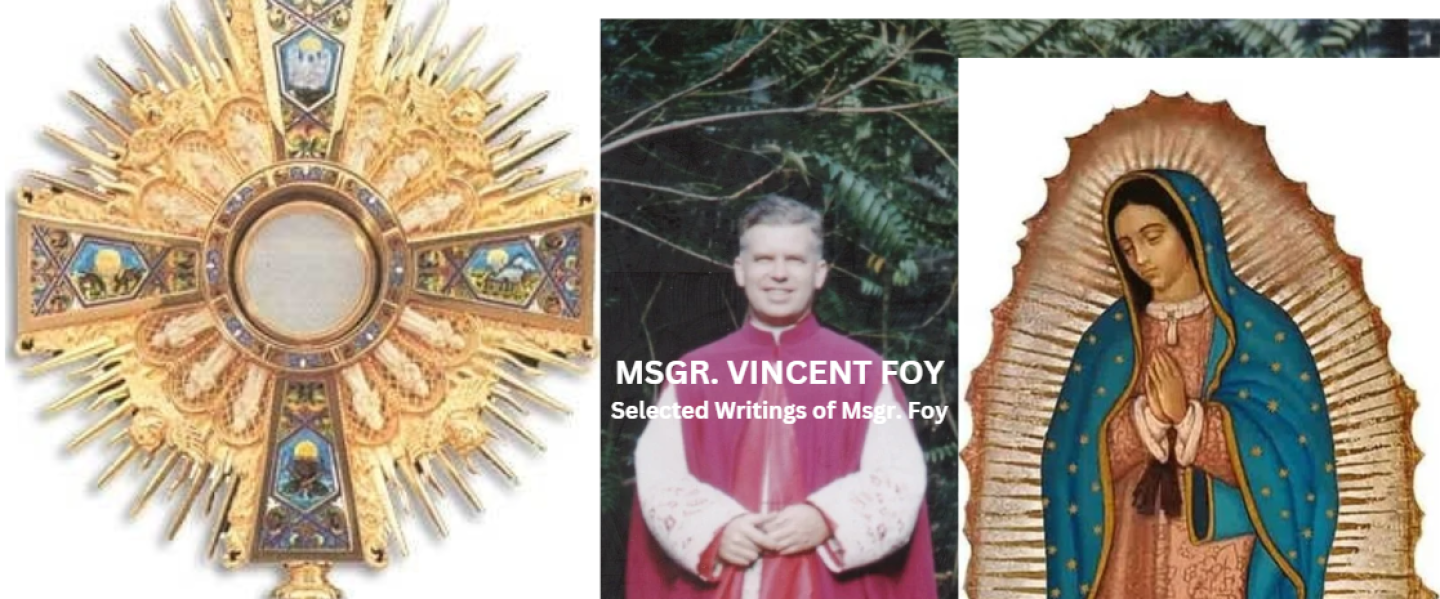
Personal Memories: “Early Sick Calls Remembered”

The following article was published in Catholic Insight, November, 2011.

Early Sick Calls Remembered 

By Msgr. Vincent Foy

If a priest is not familiar with death and dying before he is ordained, that is soon remedied afterwards. That is the way it was with me. I was ordained on June 3, 1939, at the age of twenty-three. That summer I was stationed at St. Catherine of Alexandria parish in St. Catharines, Ontario. At that time, the Niagara Peninsula was part of the Archdiocese of Toronto.

Many sick calls in the summer of 1939 are fresh in my memory. One involved a head-on collision of two radial cars between Port Dalhousie and St. Catharines. When I got to the General Hospital there were about twenty-two injured people strewn over the emergency section. Very seriously injured was the motorman of one of the cars. He held on to the controls until the crash came, whereas the other motorman jumped to save himself. The injured motorman was a Mr. Schenk, an uncle of a young man who would become Bishop John O’Mara. I entered the room where Mr. Schenk was rolling in agony. His son-in-law entered the room at the same time and fainted at the sight of his relative. Mr. Schenk was moaning, “I’m dying. I’m dying.” I obtained a General Confession and anointed him. It turned out that his severe pain was caused by a piece of wood lodged in his back. He recovered, but was a cripple for life due to severe injuries to his feet.

Another sick call in early September of 1939 was what I consider a remarkable one. One afternoon, I received a phone call in which a lady’s voice said, “I am not going to tell you who I am. A dying lady needs your help at once. She lives at [here the address was given, about three miles away]. She lives with her daughter and son-in-law. The latter would not allow a priest in the house. Now the sick lady is by herself. I ask you to go at once to look after her.” I phoned Oz Darte, the junior Funeral Director of the Darte Funeral Home. He had offered to take me on any urgent sick calls. He was then about twenty-nine and is long since deceased. He came at once and drove me to the address given. It was on the outskirts of St. Catharines, a large corner house surrounded by a picket fence. I was able to unlock a gate in the fence. As I did so, I encountered a large German Police Dog, barking furiously.

Here I would like to remark that I had an unusual fear of Police Dogs. That went back to childhood days. My mother used to get a large shipment of fresh eggs for a relative on a farm near Mildmay. She used to get enough to supply two or three neighbours with eggs at a very reasonable price. On one occasion I took a large basket of eggs to my aunt along the street. I still had two or three dozen eggs to take to a family on Nealon Ave., the street behind ours. As I was climbing over my aunt’s back fence at the corner to the next door fence, I was jumped at by a large Police Dog. In my fright I dropped the basket and most of the eggs were broken. I had to report the accident to my dear mother.

To get back to my sick call in St. Catharines, I knew I had to face the ferocious Police Dog. While barking loudly at my heels, it did not bite. The front door of the home was locked, but remarkably, the back door was open. I entered and found the dying lady on a bed on the main floor. Her eyes lit up when she saw me. I heard her confession and anointed her. Then I asked her “Would you like to receive Holy Communion in the form of Viaticum?” “Oh yes!” she replied.

So I faced the barking dog again, had Oz Darte drive me back to St. Catherine’s Church and returned with the Blessed Sacrament. Once more I went by the dog and found the woman still alone. She very devotedly received Viaticum.

It was soon after that the woman died and was buried from a funeral home.

Often I wondered who notified me of the dying woman’s need. Could it have been her Guardian Angel?

November 21, 2011

Personal Memories: “Mexico, Land of Mary’s Wonders”

Mexico, Land of Mary’s Wonders

By Msgr. Vincent Foy, Class of 1939

This is a sequel to the fine article “The Virgin of Guadalupe” which appeared in the August 2010 “Cinqdoos” newsletter. It was suggested by my tablemate at Houses of Providence, Fr. Derm Cullen.

In 1958, St. Anthony Guild Press of Paterson, New Jersey, published a book entitled, “Mexico, Land of Mary’s Wonders.”  It described, with photographs, twenty-eight Mexican Shrines to Our Lady, from Our Lady of the Immaculate Conception at Aguascalientes, to Our Lady of Covadongo, in Mexico City. I obtained a copy of this book in 1961.

Inspired by the countless miracles, cures, and favours obtained through the intercession of the Blessed Virgin in Mexico, I visited a number of these shrines. I took photographs of them, studied their history, and for a number of years, gave illustrated lectures on the shrines.

Among my most vivid memories of these shrines are those of Our Lady of Zapopan, near the city of Guadalajara, in the state of Jalisco. On December 8, 1540, a Franciscan missionary gave to the settlement at Zapopan a small image of Our Lady of the Immaculate Conception, now called Our Lady of Zapopan. For ten years, he had carried this image with him on his missionary journeys and attributed to Our Lady’s intercession his success in converting and establishing peace among the neighbouring Indians.

Our Lady of Zapopan is little more than thirteen inches in height. She has many changes of vestments for various occasions, all richly silvered and enhanced by pearls and precious stones. On her head rests a jewel-encrusted golden crown and there is a golden half-moon beneath her feet. She is venerated under many titles, including Patroness of Guadalajara, General of the Armies, and Queen of Jalisco. Each of these three has its proper history.

It would take a book to list the many graces and favours obtained through the intercession of Our Lady of Zapopan. Here is one example. The end of the seventeenth century saw Guadalajara scourged by a terrible epidemic. The Bishop ordered the statue of Our Lady of Zapopan to be carried in procession from its temple into the cathedral of Guadalajara. There are sworn medical testimonies that, following this procession, the plague ceased at once.

Following the cessation of the plague, each year, certainly up to the time I was there, Our Lady of Zapopan leaves her sanctuary on June 13 and visits the churches in every barrio of Guadalajara. I was much edified to witness the enthusiasm of the people. It seemed that the whole parish marched in procession through the streets. At the end was the parish priest, carrying the statue of Our Lady.

On October 5, Our Lady is borne back to the basilica of Zapopan in the arms of the Archbishop. The procession includes a line of cars that stretches form the cathedral of Guadalajara to the Zapopan basilica. Overhead airplanes strew flowers along the line of the march. The air is filled with hymns, almost drowning out the military bands. Far into the night are fireworks, lights and music.

No wonder the Faith is strong in Guadalajara. When I was there, the chancellor, trained in Texas during the persecution, assigned me to a daily Mass at his parish. There were six daily Masses at his large church and twelve on Sundays. The seminary was full and each year sent priests to other parts of Mexico and to South America.

Of course, the greatest shrine to Our Lady in Mexico is to Our Lady of Guadalupe. When I visited there in the early sixties, I had a letter of introduction to the rector of the shrine from Archbishop Pocock of Toronto. He and the rector had been classmates in the Catholic University of America at Washington. I arrived at the basilica at about 7:30 a.m. on a Sunday. I noticed dozens of the faithful going towards the church on their knees. The rector received me graciously and assigned me to the 8 a.m. Mass. The basilica was full, with standing room only. My back was towards the people and in front of me was the miraculous image of Our Lady. I was amazed at how brilliant the colours were on the tilma. I found it difficult to keep my eyes off that marvelous image.

When Pope Benedict XIV was first shown a reproduction of Our Lady of Guadalupe in 1752, he fell to his knees, weeping.

Pope Leo XIII said:  “Never before has it been given to us on this earth to see so lovely an image; and its loving-kindness moves us to reflect: ‘How beautiful must Mary herself be, in Heaven.’”

Our Lady of Guadalajara and Our Lady of Zapopan, pray for us.

August 14, 2010

My Dog Sandy

My Dog Sandy
My dog Sandy with a friend.

Ever since childhood I wished to have a dog as pet and companion.  My dear mother would not allow a dog in the house: she rightfully thought that eight children were enough.

My childhood wish was realized when I was appointed as pastor of St. Patrick’s parish, Phelpston, a village a few miles north of Orillia and south of Elmvale.  I was there for a year from late 1975 to late 1976.  The former pastor left to me his fine German Shepherd dog named Sandy.

Sandy had a more intimate relationship with the former pastor than I would permit.  She had the habit of sleeping on the top of his bed and had full run of the rectory.  Her usual station was a pad in the corner of the kitchen, where she was fed and watered.  My first change of discipline was to have her sleep beside the bed, instead of on top of it, and then, after several weeks, to sleep on her pad in the kitchen.  To do this I had to place a board preventing her from going upstairs.

Sandy was the Number One Dog in Phelpston.  She proudly accompanied me each weekday to the Post Office.  All other dogs kept a respectable distance.  All visitors to the rectory were considered enemies until I had given approval.

Once Fr. Jim Hayes came unannounced via the open back door.  He was immediately challenged by Sandy and felt her teeth on his leg as a warning signal.  He told me that the dog was dangerous and that I should get rid of her.  He had forgotten that once he had told me a visitor had come into his rectory without knocking and that his dog had taken the seat out of his pants.  He had justified this on the theory that no one should come without knocking and that he had a good watchdog.

Some parishioners thought Sandy a bit overzealous as a watchdog and gave her the nickname “Fang.”  The school was just behind the rectory and the teachers asked that I keep Sandy in the rectory when they came to school and when they left, and this I did.  The weekend secretary was quite afraid of Sandy and asked that I keep the door closed into her office.  On the other hand, when I had evidently approved of a visitor, Sandy was quite docile.  At a parish council meeting, when there were about ten persons in the big front room, I had Sandy greet each personally.  She would raise a front paw to be shaken by each in turn and bow her head, though it was obvious that this was most distasteful to her and she would much rather bark or bite.

Sandy loved to ride in the car.  Whenever I used the word “car” in conversation, she would jump all over me, indicating she wanted a ride.  I took her with me each Monday to make a bank deposit in Elmvale.  She would run around a bit but was waiting at the car for me when I was ready to return.  One day when I left the bank she was nowhere to be seen.  She had gone wandering and I could not find her. I drove back to Phelpston and had her disappearance announced on the radio.  The next morning I visited the school and asked the children if they had heard what happened.  They answered in unison “Sandy is missing.”  That afternoon a police cruiser drove up to the rectory in Phelpston, opened the door and Sandy made a beeline for the rectory.  The two officers told me that Sandy had evidently spent the night sitting outside the veterinarian’s office.  Sandy had a remarkable sense of location, because I had only taken her there once.

Sandy took her care of me seriously.  Once I had a weekend retreat given by Fr. Jim Bennett, a Redemptorist Father.  He slept in one of the spare rooms on the second floor of the very large old rectory.  It had no lock on it.  He rose early Sunday morning and when I joined him in the kitchen he was obviously very upset.  He said he had hardly slept.  Sandy, now sitting on her pad in the kitchen, looked the picture of innocence.  Apparently she had jumped over the board I had placed at the foot of the stairs and was determined to examine the intruder.  She nudged him in his bed and quite startled him.  When he got her out she came back.  He ended up with all the furniture in the room stacked against the door.  This whole scenario was spread over several hours.

Every evening, I let Sandy out the back door for an hour’s exercise.  As a rule she returned promptly when I opened the door an hour later.  One evening she was reluctant to return.  I tried to entice her with a wiener, but she grabbed the wiener and ran off.  So I locked her out for the night and found her patiently waiting outside the door the next morning.  She knew I was upset with her and at breakfast she came over to lick my hand, obviously begging for forgiveness.

The time came, near the end of my tenure at Phelpston, when I thought Sandy should go.  A nearby parishioner offered to take her.  He said she was just the kind of dog he wanted.  What I did not know was that Sandy was to be a stable-dog.  He already had a family dog.  The comedown was too much for Sandy.  When I visited the neighbour two weeks later, I was shocked to see Sandy.  She had refused to eat and was down to skin and bone.  I took her home and soon she was her own happy self.

The next move was Sandy’s last.  A fine Catholic family, the Daniels, who lived on spacious grounds near Elmvale, offered to take her.  I shall never forget the day I took her to her new home.  After going to the bank in Elmvale as usual on a Monday morning, we started home.  A little south of the town, instead of continuing south, we turned east towards the Daniels’ residence.  As soon as I made the turn, Sandy began to moan and groan, evidently in great distress.  I had never heard her react like that before.  By what remarkable insight did she know that she would never return to Phelpston?  Sandy was received joyously by the Daniels family and I believe she eventually felt at home there.  Anytime I visited she jumped all over me in evident welcome.  She never forgot the Phelpston days.

Early in 1977, I went to live for about two years in Rome.  Sometime in my first year there I received the sad news that Sandy had been “put down.”  She was nearly blind with age and had been much enfeebled.

So ends the realization of what I wanted as a boy: realized in My Dog Sandy.

By Msgr. Vincent Foy, Last survivor of the St. Augustine’s Seminary Class of 1939, March 31, 2010

Written for Fr. Cullen’s Ordination Class of 1952 Bulletin (Cinquante-Deux)