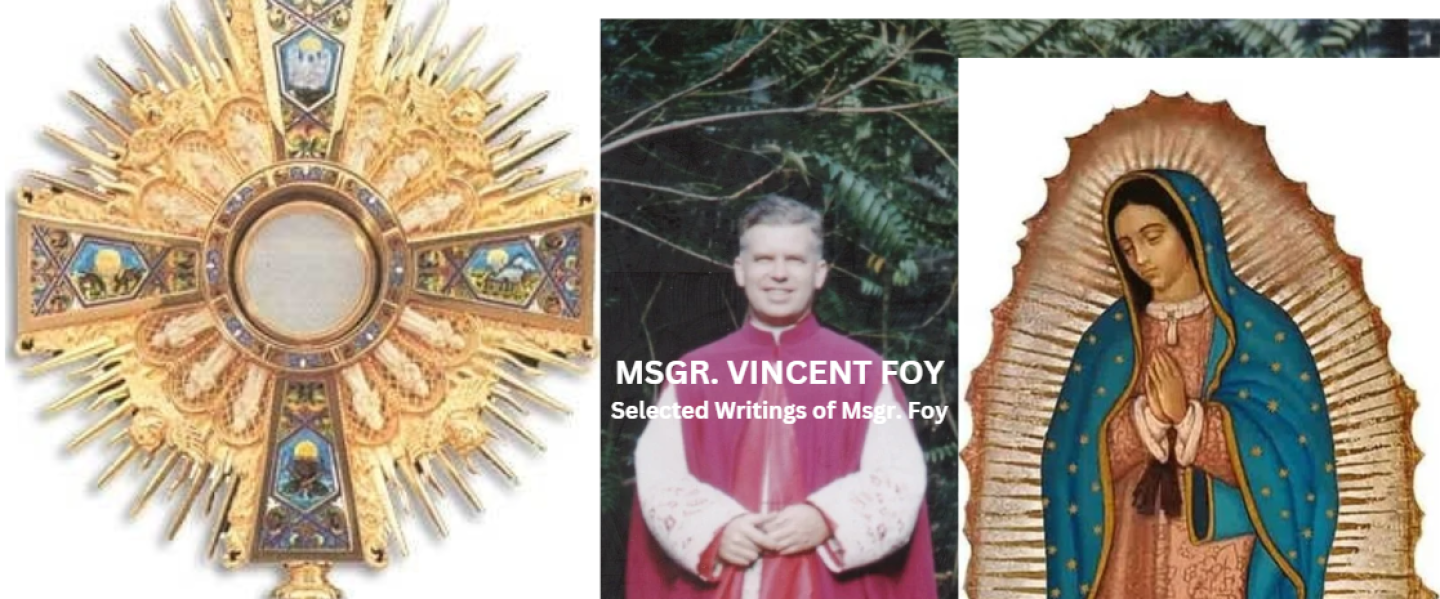

It was a scandal to many Catholics that the arch-dissenter Gregory Baum was invited to speak at Regis College, Toronto, on January 17, 1996. The scandal was amplified when it was announced that he would also speak at the Newman Centre in Toronto on May 13, 1996. In an effort to prevent this I compiled the following notes on Gregory Baum. The effort was ineffective, though there was a demonstration of loyal Catholics outside of the Newman Centre protesting the appearance there of Baum. In my opinion Gregory Baum has done more than anyone else to weaken the Catholic Church in Canada, through false ecumenism, theological errors and his opposition to the encyclical “Humanae Vitae.” — Msgr. Foy
Notes on Gregory Baum
By Their Fruits You Shall Know Them
(1996)
by Msgr. Vincent Foy
Our oldest Toronto priest, Monsignor Ralph Egan, 95, spends his days in prayer and in sending Catholic prayer books and reading material to all parts of the world – free. He often quotes St. Anthony Mary Claret: “If you can’t send a missionary, send a book.” Of course he meant a good book. He is the founder of our Toronto St. Maximilian Kolbe group which distributes free Catholic literature. He understands the value of orthodox reading. He has told me that he keeps his strong faith through prayer – and by avoiding ever reading the dissenters or listening to dissent. He was quite aghast when I told him that Gregory Baum was going to speak at Regis College in Toronto on January 17. To honour the work of Msgr. Egan and in response to some requests I have compiled some notes on the teaching and conduct of Gregory Baum, marxist and “ex-priest”. In my opinion he has done more to help destroy the Church in Canada than any other person.
Communism and Marxism
He is commended in the Canadian Tribune (official communist publication) in 1963 for asking at an Anglican Congress “whether the ideals of Marx were not aims for which the Church should have worked.”
His name led a list welcoming Rabbi Feinburg (considered Canada’s leading Fellow Traveller) back from Hanoi in 1967.
Doctrine
In the “Christian Century” for April 6, 1966, p.429, he described how Catholic theologians could work together to change what had until now been considered immutable Church teaching.
In 1965, when Pope Paul VI reaffirmed the doctrine of transubstantiation in the encyclical “Mysterium Fidei,” Gregory Baum accused the Pope of stressing Trent as against Vatican II, of wishing to slow down the movement of renewal (The Canadian Register, Sept. 25, 1965).
Gregory Baum has repeatedly called for a “magisterium of the theologians.”
The Hierarchical Church
Gregory Baum has consistently attacked the Church teaching on the hierarchy and authority of Pope, Bishops and priests.
In a compendium of views on “The Future Church,” Gregory Baum said: “Bishops and popes will not be dressed as feudal lords. They will simply be brothers who have something to say. They will have authority because they express what their brethren really believe . . . In the future Christians will not look down on their fellow citizens who differ from them nor will they regard it as their duty to convert them.” (The Telegram, Toronto, July 1, 1967)
In 1970, at a World Congress on the Future of the Church, attended by about 800 theologians, most of them Catholics, Gregory Baum said: “Theologians must stop defining the Church’s teachings by looking at Scripture and tradition and then trying to apply what they find to the world . . . Catholics have learned to look at the Church as a Christian movement in which they participate on the terms defined by their own conscience . . . Father Baum said that one consequence of the new view that secular values are a source of theology is that people have learned to ‘de-mythologize’ the Church and the authority of the high officials.”
On November 24, 1995, Pope John Paul II insisted that “Catholic theologians may not openly dissent from Church teachings or propose ideas contrary to official doctrine. It seems necessary to recover the authentic concept of authority . . . theology can never be reduced to the ‘private’ reflection of a theologian or group of theologians. The vital atmosphere for theologians is the Church.”
Obedience to Authority
In the words of Msgr. George Kelly (“The Battle for the American Church,” p. 448,9): “Gregory Baum argued that Rome’s grip on the Church can be loosened by careful violation of law. In Baum’s view freedom from Rome’s law can be obtained by seizing it in the knowledge that violations will go unpunished. Baum points to the success of religious orders and Catholic universities standing up to Rome without suffering any sanction . . . the procedure of several American dioceses admitting Catholics in second marriages to Holy Communion receives Baum’s approval because no harm comes thereby to Church unity, with Rome only ‘mildly disapproving.’”
In the National Catholic Reporter for November 10, 1972, Gregory Baum wrote: “With courage and the right kind of discretion, bishops and local churches could deal with their problems even without total approval from the papal offices – without the slightest rupture with the Pope.”
Devotion to Mary
In the early sixties I attended a dinner at Osgoode Hall under the auspices of the Catholic Lawyers’ Guild. Gregory Baum spoke on the exaggerated “cultus” of Mary in the Catholic Church. He said there was no evidence of devotion to Mary before the fourth century. At the time I had been reading a section of “Mariology” edited by Fr. Juniper Carol, O.F.M. on “The Origins and Cultus of Marian Cult.” It gave numerous examples of devotion to Mary in the first three centuries. I was convinced that Fr. Baum was deliberately lying.
Contraception
The attack on the Church’s teaching against artificial contraception has been at the core of the dissenters’ attempts to destroy papal authority. “To repudiate the teaching on contraception . . . throws open the possibility of repudiating all of these other positions (divorce, sterilization, abortion, euthanasia) as well. The skein simply unwinds.” (B.A. Santamaria). The Scottish Bishops, in their statement on “Humanae Vitae” said of the claim of dissenters that the papal decision (Humanae Vitae) did not demand assent: “Such an assertion is destructive of all that Catholics understand by the teaching authority of the Church.”
In his attempts to undermine the authority of the Pope, Gregory Baum has concentrated on destroying the credibility of the Church’s immemorial teaching against the practice of contraception. He is quite aware that in the measure in which he succeeds, the Church dies.
I point out here only a sampling of his attacks on God’s law:
- In 1964 Gregory Baum contributed to a Herder and Herder book called “Contraception and Holiness,” “a balanced and perceptive declaration of Christian dissent.” Another contributor was Stanley Kutz, C.S.B., a Baum disciple, soon to leave the priesthood.
- In 1965 he joined 37 American Catholic scholars in signing a statement calling for a “qualified endorsement of contraception” and “a change in the Church’s traditional position on birth-control.
- In 1966, in a feature article in the Toronto Globe and Mail he said, “Catholics May Use Contraceptives Now.
- In 1967 in an article in the Globe and Mail (April 23), after the majority opinions of the “Roman Catholic Birth Control Commission” had been leaked to the press, he said: “The publication of the texts will help many, many Catholics make up their own minds with a better conscience.” He said, “Some of the bishops will be quite annoyed that they were not at all informed of these developments.”
- In 1967 in the Toronto Star (May 6) he says that a liberalizing in his Church’s attitude is inevitable not only in regard to birth control but to divorce and mixed marriages as well. He said Pius XI was pushed into writing “Casti Connubii” in 1930 by “Belgian theologians” and “It is my personal conviction that Pius XI made a mistake and that in a very few years we will accept the teaching of the Anglican Bishops in 1930.”
- In 1968, after the encyclical “Humanae Vitae” was published, he said: “The Pope’s decisions went against the majority report of his own study commission, against the almost unanimous voice of the Lay Congress held in Rome last year, against the wishes of many bishops expressed at the recent meeting of the Synod, and against the weight of contemporary Catholic theology. The Pope rejected the Christian experience of vast numbers of Catholics and the witness of other Christian Churches . . . Catholics who cannot accept the papal teaching on birth control need not leave the Catholic Church. Nor do they become hypocrites by staying in the Church. If they have formed deep convictions on the morality of birth control, they may dissent from the official position and follow their own tested conscience.” (Globe and Mail, August 1, 1968).
The objections raised here against Humanae Vitae were precisely those given by some Bishops and “periti” at Winnipeg in the following month. If it had not been for the black shadow of Baum over Winnipeg, his influence over some Bishops, the Canadian theological establishment and pressure groups, the Winnipeg Statement of the Canadian Bishops on “Humanae Vitae” would not have refused to endorse the teaching of the encyclical as it did. It would have been an enthusiastic endorsement of the Church’s Charter of life and love, and the Church in Canada would not now be in a precipitous decline.
Conscience
Although he did not criticize the Winnipeg Statement of the Canadian Bishops in which their concept of conscience was open to criticism, when they did issue a Statement on Conscience which was in accord with Catholic doctrine he publicly criticized it. (December 1973).
On Human Sexuality
In the 1960’s, Gregory Baum was supportive and involved with a psychotherapy group with headquarters in three houses on Admiral Road in Toronto. A number of priests, nuns and Catholic students joined the group set up originally to explore alternatives to marriage. It gave great concern to Father John Kelly, President of St. Michael’s College. An article in The Telegram (Feb. 27, 1968) stated “Father Kelly continues to worry about the way promising priests, student priests and nuns join the group and begin to ease away from their religious duties.” More unsavoury details could be given.
When the “Declaration on Certain Questions Concerning Sexual Ethics” was issued by the Sacred Congregation for the Doctrine of the Faith on December 29, 1975, Gregory Baum criticized it severely. He said: “The concept of sex only within marriage was no longer adequate. Even if marriage is the ideal, this does not mean that there is no responsible context of sexual relations for mature single people, the widowed and the divorced.” In response, Archbishop Pocock declared: “Rev. Gregory Baum’s recently published reactions to a Vatican document on sexual conduct are contrary to official Catholic doctrine and may not be followed as either the teaching or the practice of the Catholic Church.” Father Baum was suspended from hearing confessions.
Gregory Baum was a consultor with Charles E. Curran and Richard McCormick, S.J., on the book “Human Sexuality.” Among other things, it said: “The final word on mate swapping has not been said.” It claimed that there may occasionally arise exceptions to the prohibition of adultery, and “premarital intercourse may be justified if it represents a loving relationship and some measure of mutual commitment before sexual involvement.” This study was condemned by the American Bishops (Origins, June 9, 1977).
Scripture
Some insight into his rejection of Scripture as a basis for certainty or belief is given in a book: “The Credibility of the Church Today. A Reply to Charles Davis.” A review of the book says “One is driven to think it is so uncertain what Our Lord actually said and did, that the immense claims made for scripture as the touchstone for Christian Churches can hardly be maintained.” (Douglas Woodruff in Catholic Truth, Spring, 1969). One writer described the book by saying: “Fr. Baum’s reply to Davis seems to be much the same as Fr. Loisy’s to Harnack.” (John McKee in “The Enemy Within the Gate”, Lumen Christi Press, 1974, p.27).
He has repeatedly condemned the Catholic teaching on the inerrancy of Scripture.
The Priesthood
In conducting laicization cases of Toronto priests, I called Gregory Baum a witness only once. I realized that he promoted the concept of a temporary or “existential” priesthood – i.e., it may have been relevant yesterday but not necessarily today.
In the Daily Star of April 23, 1966, in an article entitled “Exodus,” Baum said he was not alarmed at the large numbers of priests and religious departing from their vocations. He said: “By assigning the laity a higher place in the Christian Church, the whole matter of the role of the clergy has to be re-thought.”
Status
In its issue of January 14, 1978, the Catholic Register reported that “Gregory Baum, noted Canadian theologian and outspoken critic of the Church, married a former nun in a private ceremony recently in Montreal . . . the bride is Shirley Flynn, who left her religious order about 15 years ago.” He had previously cancelled an application for laicization. According to Canon 2388 of the Code of Canon Law in force at that time, he was automatically excommunicated. I do not know his present status. He is not a Catholic theologian except by his own definition of the term. In 1980, when Hans Kung was declared not to be a Catholic theologian, a group of “60 American and Canadian Catholic theologians, including Baum, issued a declaration that they would continue to regard Kung as a Catholic theologian.”
Conclusion
The above notes are a superficial glance at some of the teachings and activities of Gregory Baum.
I have not touched on his errors in his books, in Concilium, his column in the Catholic Register in the sixties called “The Church To-Day”, the Ecumenist, Compass, Commonweal, the Homiletic and Pastoral Review (in the sixties), Catholic New Times, of which he was a co-founder, and in his widely circulated tapes.
I have not examined his influence at Vatican II, his penetration of religious orders and communities, e.g., the Basilians and the Society of Jesus, his major role in the destruction of the Catholic Family Movement in Canada, his work through surrogates, his indirect influence on the Statements of the Canadian Bishops on contraception and divorce vs. civil law, his indirect influence on teaching at St. Augustine’s Seminary, his indirect influence on the Winnipeg Statement, his part in the decline of the Church in Quebec through his teaching, influence over some Quebec Bishops and support of theologians in their uprising against the encyclical “Veritatis Splendor.”
Nor have I considered his widespread influence through societies, groups, national and international congresses and protests of rebellious theologians. Cardinal Heenan had the good judgement to ban him from speaking at a Catechetical Convention in London.
In conclusion, the reason why I believe Gregory Baum should not have been permitted to occupy the Catholic podium at Regis College in Toronto on January 17, 1996, is that he consistently advocates immorality and teaches error.
These are the reasons why I believe Catholics should respectfully request our Archbishop not to permit Gregory Baum to speak at the Newman Centre in Toronto. A flyer is now widely circulating which reads: “Remembering Vatican II – Memories of the Council from one who was there – a lecture by Professor Gregory Baum, Peritus at the Council, Theologian, writer – Monday, May 13, 1996, 8:00 p.m., The Oak Room, of the Newman Centre of Toronto. The lecture is Free and Open to the Public.”
Those who wish to voice their concerns may write to:
The Newman Centre,
Roman Catholic Chaplaincy,
University of Toronto,
89 St. George Street,
Toronto, ON, M5S 2E8
Phone: 416-979-2468
It would be a marvelous gift to the people of Canada if the CCCB were to set up a commission to study the influence of Gregory Baum on the Church.
We need all pray. In the words of a breviary intercession of to-day’s Office:
“Christ nourishes and supports the Church for which He gave Himself up to death. Let us ask Him: Remember Your Church, Lord.”
(Msgr.) Vincent Foy
Retired Priest
Archdiocese of Toronto
January 24, 1996
Feast of St. Francis de Sales,
Patron Saint of Journalists
Printable copy Notes on Gregory Baum – by their fruits you shall know them


You must be logged in to post a comment.