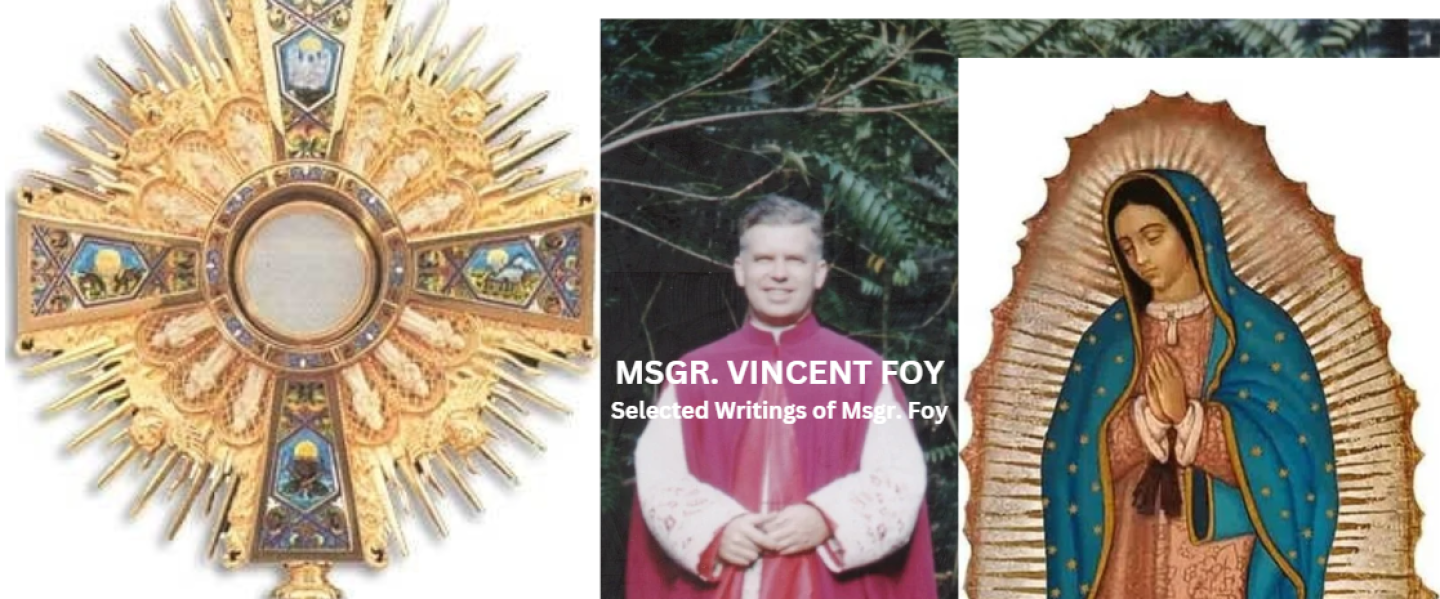
Personal Memories: “Early Sick Calls Remembered”

The following article was published in Catholic Insight, November, 2011.

Early Sick Calls Remembered 

By Msgr. Vincent Foy

If a priest is not familiar with death and dying before he is ordained, that is soon remedied afterwards. That is the way it was with me. I was ordained on June 3, 1939, at the age of twenty-three. That summer I was stationed at St. Catherine of Alexandria parish in St. Catharines, Ontario. At that time, the Niagara Peninsula was part of the Archdiocese of Toronto.

Many sick calls in the summer of 1939 are fresh in my memory. One involved a head-on collision of two radial cars between Port Dalhousie and St. Catharines. When I got to the General Hospital there were about twenty-two injured people strewn over the emergency section. Very seriously injured was the motorman of one of the cars. He held on to the controls until the crash came, whereas the other motorman jumped to save himself. The injured motorman was a Mr. Schenk, an uncle of a young man who would become Bishop John O’Mara. I entered the room where Mr. Schenk was rolling in agony. His son-in-law entered the room at the same time and fainted at the sight of his relative. Mr. Schenk was moaning, “I’m dying. I’m dying.” I obtained a General Confession and anointed him. It turned out that his severe pain was caused by a piece of wood lodged in his back. He recovered, but was a cripple for life due to severe injuries to his feet.

Another sick call in early September of 1939 was what I consider a remarkable one. One afternoon, I received a phone call in which a lady’s voice said, “I am not going to tell you who I am. A dying lady needs your help at once. She lives at [here the address was given, about three miles away]. She lives with her daughter and son-in-law. The latter would not allow a priest in the house. Now the sick lady is by herself. I ask you to go at once to look after her.” I phoned Oz Darte, the junior Funeral Director of the Darte Funeral Home. He had offered to take me on any urgent sick calls. He was then about twenty-nine and is long since deceased. He came at once and drove me to the address given. It was on the outskirts of St. Catharines, a large corner house surrounded by a picket fence. I was able to unlock a gate in the fence. As I did so, I encountered a large German Police Dog, barking furiously.

Here I would like to remark that I had an unusual fear of Police Dogs. That went back to childhood days. My mother used to get a large shipment of fresh eggs for a relative on a farm near Mildmay. She used to get enough to supply two or three neighbours with eggs at a very reasonable price. On one occasion I took a large basket of eggs to my aunt along the street. I still had two or three dozen eggs to take to a family on Nealon Ave., the street behind ours. As I was climbing over my aunt’s back fence at the corner to the next door fence, I was jumped at by a large Police Dog. In my fright I dropped the basket and most of the eggs were broken. I had to report the accident to my dear mother.

To get back to my sick call in St. Catharines, I knew I had to face the ferocious Police Dog. While barking loudly at my heels, it did not bite. The front door of the home was locked, but remarkably, the back door was open. I entered and found the dying lady on a bed on the main floor. Her eyes lit up when she saw me. I heard her confession and anointed her. Then I asked her “Would you like to receive Holy Communion in the form of Viaticum?” “Oh yes!” she replied.

So I faced the barking dog again, had Oz Darte drive me back to St. Catherine’s Church and returned with the Blessed Sacrament. Once more I went by the dog and found the woman still alone. She very devotedly received Viaticum.

It was soon after that the woman died and was buried from a funeral home.

Often I wondered who notified me of the dying woman’s need. Could it have been her Guardian Angel?

November 21, 2011

“Monsignor Vincent Foy’s Life Devoted to the Church”, December 2002, Shepherds’ Trust Newsletter

The following is an interview by  “Shepherds’ Trust Newsletter” (a publication of the Archdiocese of Toronto, and which is dedicated to supporting the needs of retired clergy) with Monsignor Foy and which appeared in the Winter, 2002 edition.


Scan_20140324The bank of file cabinets along one living room wall and the large, paper-strewn desk opposite tell the visitor that Monsignor Foy is active in retirement.

“I keep busy with my research and my writing,” he says. “For example I’ve had a number of articles published on causes I believe deeply in, especially the Pro-Life movement. I’m also a member of the Board of the Call to Holiness Canada movement.”

“In order of ordination, I am now third in the archdiocese,” he says. “I was ordained in 1939. The discipline in the Seminary then was strict. One could be expelled for having a newspaper in one’s room, for allowing another seminarian to enter one’s room, or for having an alcoholic beverage, even while on vacation. Discipline in recent years has gone to the other extreme. Perhaps that is one reason why vocations are down so drastically. We all need a sense of order and a willingness to deny ourselves.”

Monsignor Foy was baptized at St. John’s Parish, in Scarborough. As a child he lived in Holy Name Parish, also in the east end. “Our pastor was a great role-model, ” he says “There were always thirty or forty altar boys, and we all had to be there for the 11a.m. Mass on Sunday and then in the evening for Benediction. I was about ten when I knew that I wanted to be a priest. Nothing else even occurred to me.”

“I entered St. Augustine’s seminary in 1933 and was ordained in 1939.  I was to study Canon Law in Rome, but the start of World War II complicated things, and I ended up at Laval University in Quebec City. In those days there was no salary or allowance for student priests and so I spent three years in real poverty. I did receive thirty dollars per month for the summers spent working in the Chancery Office. In 1942 I was posted full-time to the Chancery Office, and for some time I lived at Blessed Sacrament rectory before moving to the Cathedral.”

Monsignor Foy spent nearly twenty-five years in marriage tribunal work. He said, “When the Toronto Provincial Tribunal was set up in 1948, I was its only full-time member. Later, I was joined by Father Fulton (now Bishop Fulton) and then Father Courtemanche. Fr. Clune, now Bishop Clune, was a part-time member. We were fortunate in having Margaret Cronin as our first full-time secretary. She could translate evidence into French and at that time all cases going to Rome had to be in French, Italian, Spanish or Latin.”

In 1957 Monsignor was appointed the head of the Archdiocesan and Provincial marriage tribunals and named a Monsignor. He is the last of Monsignors in Toronto Archdiocese created by Pope Pius XII. The adage, “If you want something done, give it to a busy man.” comes to mind with his next words: “During this time, I was also Director of Catechetics for the Archdiocese. It was a part-time assignment but I had the duties of approving texts, setting annual examinations, marking the top papers from the whole Archdiocese, and organizing summer school and the annual Catechetical day in the Cathedral. All of this was on a budget of sixty dollars per month for postage. Any additional expenses were to be paid from the Tribunal budget.”

In 1966 all this changed.  Monsignor Foy was assigned to St. John’s Parish as Pastor. “Imagine coming home as Pastor to the church where you were baptized!” he marvels. Pastorally, it was a difficult time. The quite revolutionary changes following Vatican II were not always welcomed, especially the liturgical changes. Seven and a half years later he was transferred to “one-man parishes” in Bradford and Phelpston for the remainder of his service as a pastor.

Ill health forced an early retirement.  However, he continues pastoral visitations at Providence Villa and other long-term care facilities. His work in support of the Pro-Life movement has been described above, and continues unabated. He has won a number of awards in recognition for his Pro-Life writings.

Three final questions prompt him to reflect a little further. When asked to describe a memorable experience during his priesthood, he thought quietly, and then said, “Always daily Mass remains my most memorable experience. That Rosary hanging there also brings back vivid memories. When I was living in Rome, it was blessed by Pope Paul VI. I was often on papal ceremonies as a Eucharistic minister. When he died I touched this Rosary to his hands just before the coffin was closed. It was then blessed by Pope John Paul I and again touched his hands after his death. It was also blessed by Pope John Paul II. I hope to be buried with it.”

What about The Shepherds’ Trust? “Some of our priests are in need, and for them, The Shepherds’ Trust ensures that they are not neglected. I knew real poverty when I was studying at Laval; compared to that, what the Trust provides is a real bonus!”

What does he hope to be remembered for? That one is easy. “For fidelity,” he says. “Fidelity to the Church and to the teachings of the Church… and trying to live that fidelity. We must stay with Peter. Living the truth means that we are living with Love and in Love. It’s as simple as that.”

Personal Memories: The Seventieth Anniversary of Ordination, June 3, 2009

The Seventieth Anniversary of Ordination, June 3, 2009

By Msgr. Vincent Foy

Introduction

Your Grace, Your Excellencies, Rev. Msgrs., Rev. Fathers, Rev. Brother, Rev. Sisters and dear relatives and friends:

I have waited 70 years for this day.

There have been a few changes in seventy years.

My ordination suit, donated by my Aunt Agnes and Uncle Will, cost $29.95. It was made to order by Tip Top Tailors: there were two pairs of trousers and a vest. My ordination shoes, of fine English leather, given to me by my Aunt Elizabeth, cost $6.00 – no GST.

Down Memory Lane

Permit me to take a brief journey down memory lane. Our 1939 ordination class was the last admitted to St. Augustine’s Seminary, in 1933, under Archbishop Neil McNeil, who died in 1934.

In 1936, we were told that there were too many of us, and that unless some of us volunteered for other dioceses, some of the Toronto seminarians would be asked to leave. We all went, one by one, to the rector’s office and volunteered to go wherever we were sent. Two of us were given to the new diocese of Nelson, BC, and two to Kingston Archdiocese. Three were loaned for three years to Western Canadian dioceses. Two of us were sent away for further studies.

I was almost ordained nearly 71 years ago. In September of 1938, Msgr. Brennan, the seminary rector, called me into his office. He said I would be ordained privately in two weeks. I was to tell no one, except my parents, who were permitted to visit me for a farewell. Archbishop McGuigan was going to take me to Rome, where I was to continue my fourth year of theology with my first year in post-graduate Canon Law. So for two weeks, I worked feverishly to prepare to offer the Latin Mass and packed my trunk and was ready to go.

The night before the date set for my ordination, I knocked on Msgr. Brennan’s door. He invited me to come in and I said “Msgr., I believe I am to be ordained tomorrow.” He looked surprised. “Oh” he said, “I forgot to tell you. It is all off. You can unpack. You are going to be ordained with the rest of the class next June. The Archbishop will take you to Rome next year.” No reason was given. It was years later when I was vice-chancellor and had access to the priests’ files, that I learned the reason. The Apostolic Delegate had refused to grant the necessary dispensation for insufficient age. In Sept of 1938, I had just turned 23.

So, I was ordained on June 3, 1939, one of a class of thirty-four.

The Class of 1939

I would like to pay tribute to the class of 1939, though there was no episcopal timber among us. In Fr. Murray Allen we had the brother of a bishop: Bishop Francis Allen, once pastor of this parish. I used to help him here by hearing children’s confessions.

Seven of our class belonged to the Scarborough Foreign Mission Society and served the Church in China, Japan, the Dominican Republic and other places. One, Fr. Francis Diemert, became the Superior General of the Society.

Fr. Jim Sheridan became head of Classics at St. Michael’s College. Fr. John Bouvier became a professor at St. Augustine’s Seminary.

Three of our number became Chancellors of their Dioceses: Msgr. Flynn in Nelson, BC, Msgr. Hubicz in Winnipeg and Msgr. Welsh in Kingston.

Four of the class of ‘39 served as military Chaplains. Fr, Hank McFadden of Ogdensburg was decorated for bravery in the North African campaign of World War II. Fr. Richard Ward, first chaplain in the Korean War, my closest friend, died a hero’s death trying to rescue nuns when a plane crashed into a convent near Ottawa in 1956.

Most of our class became parish priests. I served in the diocesan and provincial matrimonial tribunal courts for twenty-five years before becoming pastor of my natal parish of St. John’s in 1967 and later pastor of Holy Martyrs of Japan parish in Bradford and St. Patrick’s parish in Phelpston.

I salute all my dear classmates. They have all gone to God. They helped in their way to build up the Mystical Body of Christ.

The Priesthood

Now a word about the Priesthood… I can say with certitude that there was no identity crisis among priests of the class of 1939. We knew we were priests forever and that our model was Christ, the great high Priest. There were no dissenters. We knew that the teaching of the Church is the teaching of Christ. We knew the importance of devotion to Mary. Our class motto was “Nihil nobis nisi per Mariam” — “Nothing comes to us except through Mary”.

When I left the Matrimonial Tribunal in 1966, I was given a beautiful watercolour painting of a chalice set in the middle of vines and grapes. That painting reminds me that the chalice is the symbol par excellence of the priesthood.

First of all there is the chalice of joy and consolation. There is an abiding inner joy in the priesthood associated with its many consolations: so many opportunities to bring grace through the sacraments and help in many ways. I think of the many thousands of times I have been able to say, in the place of Christ “I absolve you from your sins.”

There is the chalice of suffering. Every priest must spend his hour in the Garden of Gethsemani and join Simon of Cyrene in helping Christ carry the cross to Calvary. But God has graciously put a time limit on all earthly sickness and sorrow.

Above all there is the chalice of sacrifice, the greatest privilege in the world; that of standing in the place of Christ to offer the sacrifice of the Mass: to glorify God and Our Blessed Mother and all the angels and saints, for the souls of the departed and for the living.

Permit me to do a little boasting. I have been privileged to offer Mass in numerous places, signifying the Catholicity of the Church: at the Church of the Annunciation in Nazareth, at the Church of the Holy Sepulchre in Jerusalem, at St. Peter’s Basilica in Rome, at the Shrine of Our Lady of Loreto, at the tomb of St. Francis of Assisi, beside the body of Pope St. Pius X when it was brought to St. Mark’s in Venice in April of 1959, at the great cathedral of St. Stephen in Vienna, in a village Church in Hungary during the Russian occupation, at the Shrine of St. Bernadette of Lourdes, beside the body of St. John Vianney at Ars using his chalice, in the ancient Cathedral of Cologne, in Westminster Cathedral in London, the private chapel of Cardinal Newman in Birmingham using his chalice, in the pro-cathedral in Dublin, the Shrine of Our Lady of Guadalupe in Mexico and many other places.

I was privileged to be a Eucharistic minister at many papal Masses, including the funeral of Pope Pius VI, the inaugural Mass of Pope John Paul I, his funeral, and the inaugural Mass of Pope John Paul II. All of this points to the centrality of the Eucharist in a priest’s life, and that it is the priesthood that we are honoring today.

Gratitude

I cannot let this occasion pass without an expression of thanks and gratitude. First, I am grateful to God. Christ said: “You have not chosen Me, but I have chosen you”. This is a great mystery, the choosing of such a weak instrument.

I am grateful to my dear departed parents for their many sacrifices on my behalf. I am grateful to my brothers and sisters and all my relatives and in-laws. I single out my dear sister Doreen, a registered nurse, an angel of love and mercy to all the family, and my sister Shirley, here today. I thank my sister-in-law, Pauline Foy, for countless acts of help.

Sincerest thanks to Archbishop Collins, to Bishop Lacey and to this parish, who graciously hosted this occasion.

I thank and all who have helped with this celebration.

I thank the many priests who inspired me and my priest-friends who have been my help and companions. I thank my teachers, especially the De La Salle brothers who taught me in high school and who are taking care of me in the old age.

There are many here to whom I owe much. I wish to single out many outstanding pro-life workers who are here. What a great and noble and difficult work it is, trying to restore in Canada the Culture of Life.

Once when I was walking along a road near Rome, I met a small group of children. As they passed, they raised their arms and said “Salve!” — “Hail!”. I thought to myself: children were using that same beautiful greeting two thousand years ago. In similar vein, I say to you “Ave! Salve! Vale!” — “Hail and farewell and may it go well with you!”

May God bless you! Amen.