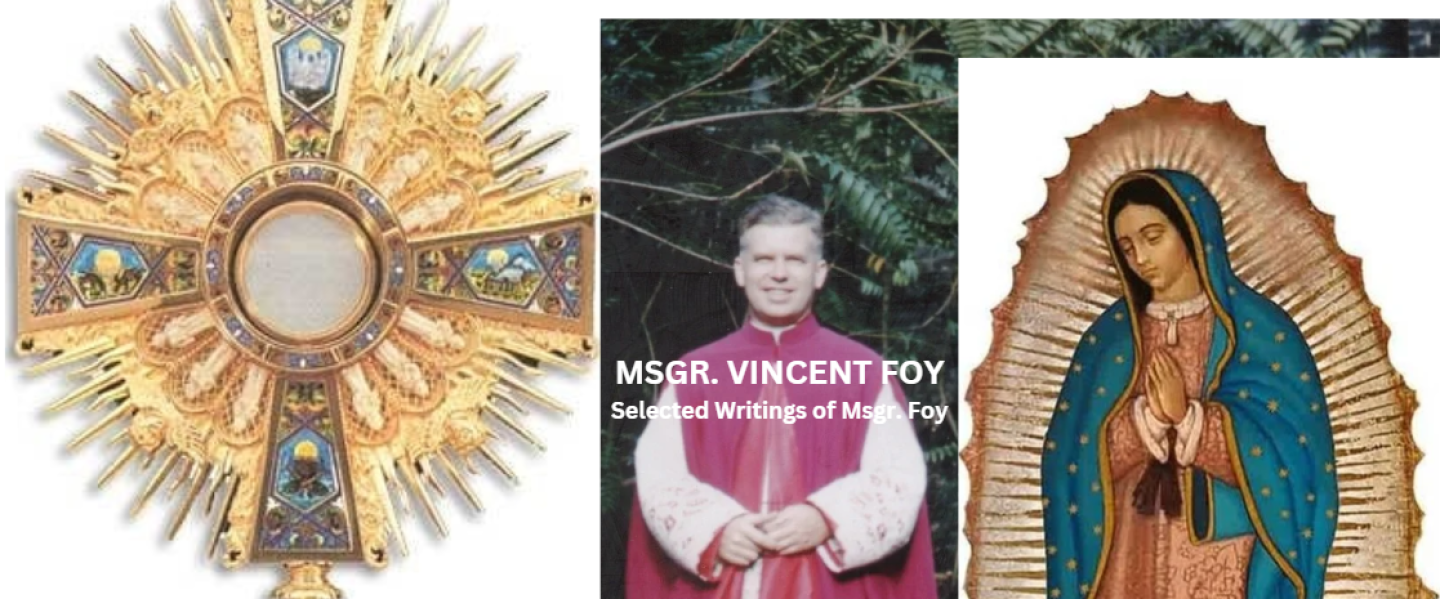
“Monsignor Vincent Foy’s Life Devoted to the Church”, December 2002, Shepherds’ Trust Newsletter

The following is an interview by  “Shepherds’ Trust Newsletter” (a publication of the Archdiocese of Toronto, and which is dedicated to supporting the needs of retired clergy) with Monsignor Foy and which appeared in the Winter, 2002 edition.


Scan_20140324The bank of file cabinets along one living room wall and the large, paper-strewn desk opposite tell the visitor that Monsignor Foy is active in retirement.

“I keep busy with my research and my writing,” he says. “For example I’ve had a number of articles published on causes I believe deeply in, especially the Pro-Life movement. I’m also a member of the Board of the Call to Holiness Canada movement.”

“In order of ordination, I am now third in the archdiocese,” he says. “I was ordained in 1939. The discipline in the Seminary then was strict. One could be expelled for having a newspaper in one’s room, for allowing another seminarian to enter one’s room, or for having an alcoholic beverage, even while on vacation. Discipline in recent years has gone to the other extreme. Perhaps that is one reason why vocations are down so drastically. We all need a sense of order and a willingness to deny ourselves.”

Monsignor Foy was baptized at St. John’s Parish, in Scarborough. As a child he lived in Holy Name Parish, also in the east end. “Our pastor was a great role-model, ” he says “There were always thirty or forty altar boys, and we all had to be there for the 11a.m. Mass on Sunday and then in the evening for Benediction. I was about ten when I knew that I wanted to be a priest. Nothing else even occurred to me.”

“I entered St. Augustine’s seminary in 1933 and was ordained in 1939.  I was to study Canon Law in Rome, but the start of World War II complicated things, and I ended up at Laval University in Quebec City. In those days there was no salary or allowance for student priests and so I spent three years in real poverty. I did receive thirty dollars per month for the summers spent working in the Chancery Office. In 1942 I was posted full-time to the Chancery Office, and for some time I lived at Blessed Sacrament rectory before moving to the Cathedral.”

Monsignor Foy spent nearly twenty-five years in marriage tribunal work. He said, “When the Toronto Provincial Tribunal was set up in 1948, I was its only full-time member. Later, I was joined by Father Fulton (now Bishop Fulton) and then Father Courtemanche. Fr. Clune, now Bishop Clune, was a part-time member. We were fortunate in having Margaret Cronin as our first full-time secretary. She could translate evidence into French and at that time all cases going to Rome had to be in French, Italian, Spanish or Latin.”

In 1957 Monsignor was appointed the head of the Archdiocesan and Provincial marriage tribunals and named a Monsignor. He is the last of Monsignors in Toronto Archdiocese created by Pope Pius XII. The adage, “If you want something done, give it to a busy man.” comes to mind with his next words: “During this time, I was also Director of Catechetics for the Archdiocese. It was a part-time assignment but I had the duties of approving texts, setting annual examinations, marking the top papers from the whole Archdiocese, and organizing summer school and the annual Catechetical day in the Cathedral. All of this was on a budget of sixty dollars per month for postage. Any additional expenses were to be paid from the Tribunal budget.”

In 1966 all this changed.  Monsignor Foy was assigned to St. John’s Parish as Pastor. “Imagine coming home as Pastor to the church where you were baptized!” he marvels. Pastorally, it was a difficult time. The quite revolutionary changes following Vatican II were not always welcomed, especially the liturgical changes. Seven and a half years later he was transferred to “one-man parishes” in Bradford and Phelpston for the remainder of his service as a pastor.

Ill health forced an early retirement.  However, he continues pastoral visitations at Providence Villa and other long-term care facilities. His work in support of the Pro-Life movement has been described above, and continues unabated. He has won a number of awards in recognition for his Pro-Life writings.

Three final questions prompt him to reflect a little further. When asked to describe a memorable experience during his priesthood, he thought quietly, and then said, “Always daily Mass remains my most memorable experience. That Rosary hanging there also brings back vivid memories. When I was living in Rome, it was blessed by Pope Paul VI. I was often on papal ceremonies as a Eucharistic minister. When he died I touched this Rosary to his hands just before the coffin was closed. It was then blessed by Pope John Paul I and again touched his hands after his death. It was also blessed by Pope John Paul II. I hope to be buried with it.”

What about The Shepherds’ Trust? “Some of our priests are in need, and for them, The Shepherds’ Trust ensures that they are not neglected. I knew real poverty when I was studying at Laval; compared to that, what the Trust provides is a real bonus!”

What does he hope to be remembered for? That one is easy. “For fidelity,” he says. “Fidelity to the Church and to the teachings of the Church… and trying to live that fidelity. We must stay with Peter. Living the truth means that we are living with Love and in Love. It’s as simple as that.”

Archbishop Denis O’Connor, Fifth Bishop and Fourth Archbishop of Toronto

Archbishop Denis O’Connor, Fifth Bishop and Fourth Archbishop of Toronto

By Monsignor Vincent Foy

Early Years

Archbishop Denis O’Connor, who followed Archbishop John Walsh, was born on a farm in Pickering Township, Ontario, on March 28, 1841. He was the only Toronto Archbishop to be born in the present area of the Toronto Archdiocese. He was the eldest of three children, though after his mother’s early death his father remarried and had ten children by his second wife.

As an infant, Denis O’Connor was brought to St. Paul’s Church in Toronto for baptism, since there was no priest nearer his home. After attending a rural school he went as one of the first residents to St.Michael’s College in September, 1852, which had just opened on Queen Street. He entered the Basilian Novitiate in 1859, was professed in 1860, and in 1861 was sent to France, where he studied for two years before he was forced to return because of tuberculosis. He was ordained on December 8th, 1863, but immediately sent on sick leave. His stepmother in Pickering nursed him back to health.

Late in 1864 he returned to St. Michael’s College for light work, filling in for absent teachers, but in 1867 his health failed again and he spent most of that year on sick leave. In 1868 he was well enough to become the acting Superior of St. Michael’s College.

Assumption College at Sandwich had been closed for some time. Fr. O’Connor was sent there as its Superior and second founder in 1870. He nursed the College into flourishing health and taught there for twenty years. At the same time he acted as pastor at Sandwich and Amherstburg. In 1888 Pope Leo X111 conferred on him an honorary Divinity degree.

A contemporary at Assumption College gave this description of Fr. O’Connor: “He was made of sterling stuff. He was physically handsome and mentally vigorous, kind of heart, severely strict in discipline towards himself and others. He was a born leader and a prudent administrator”. Another said: “His word was law and that law was obeyed or he knew the reason why. He lived frugally and worked industriously. He guided his life by three rules: prayer, work, and the instruction of the young”.


Bishop of London

Widely respected, Fr. Denis O’Connor was named Bishop of London, Ontario, on July 18th, 1890. He was consecrated in St. Peter’s Cathedral, London, on October 19th, 1890, by Archbishop Walsh of Toronto, Bishop John Foley of Detroit, and Bishop Thomas Dowling of Hamilton. During the nine years he served there he established three new parishes and St. Joseph’s Hospital in London. He was not an innovator and believed his principal duty was to strengthen existing institutions and so build up the Church and family life.


Archbishop of Toronto

On January 27th, 1899, Bishop O’Connor was appointed Archbishop of Toronto. He did not feel equal to the new responsibilities and petitioned the Holy See to remain in London, but this was refused. He was installed in St.Michael’s Cathedral on May 3rd, 1899, in the presence of the Archbishop of Kingston, the Bishops of Hamilton, Peterborough, Alexandria, Sherbrooke, St.Hyacinthe, Detroit and Buffalo and about one hundred and fifty priests.

Archbishop O’Connor took sick shortly after his installation, but on his recovery began nine years of dedicated labor. He was a relentless disciplinarian, strict with himself as with others, and this led to many difficulties.

In 1900, Archbishop O’Connor issued “Regulations to be Observed to Ensure Uniformity and Good Order”. These were thirty-five rules covering four areas: clerical discipline, liturgical uniformity, effective catechesis and adherence to Church Law by the laity in sacramental and social matters.

Shortly after his installation, the Archbishop also implemented a program to educate and improve discipline in the clergy. There were to be biannual meetings, including examinations for all priests ordained less than five years.

When Pope Pius X issued his Motu Proprio of 1903 standardizing liturgical music and reinstating Gregorian Chant, the Archbishop tried to implement this reform in all parishes, but this order was not always obeyed.

Other disciplinary steps were unpopular in the extreme. The Archbishop disapproved of Church picnics, public processions, parish excursions, and entertainments, which he considered denigrating to the truth of the Faith. His disfavor of picnics was often ignored. He also banned new societies such as the Knights of Columbus. They were not allowed until the time of his successor.

It was Archbishop O’Connor’s opposition to mixed marriages which brought him the greatest opposition. He considered that only the gravest reasons merited a dispensation. In his tenure mixed marriages dropped from 15% of marriages to 2.45%.

The policy of the Archbishop on mixed marriages, approved by some, was opposed by many. Father James Cruise, pastor of Our Lady of Lourdes parish, and Father Frederick Rohleder, rector of St.Michael’s Cathedral, and some others, incurred the wrath of the Archbishop by appealing directly to the Apostolic Delegate, Archbishop Sbaretti, for dispensations. The latter granted some without notifying Archbishop O’Connor. He complained to Rome and tried to resign in 1904 and again in 1905. The Holy See rejected these applications, assuring the Archbishop that his vigilance was appreciated. A third attempt in 1907 was finally accepted and on May 4th, 1908, he departed as Archbishop and was named Archbishop of Laodicea.


Final Years

Archbishop O’Connor spent his final years in a monastic way of life at St.Michael’s Novitiate in Toronto.  He read no newspapers and had few contacts with the outside world. To some he was a saint and a martyr. He was certainly humble and deeply spiritual, caught in a current of rapid spiritual change. As Professor Mark McGowan said in a paper on Archbishop O’Connor, “He was aware of his shortcomings, warning Rome from the beginning that he was not the man for Toronto.  In the end his own words testify to this: ‘I am sorry to state that all my anticipations concerning my position must have been fully realized’”.

Archbishop O’Connor outlived his successor, Archbishop McAvoy, and died on June 30th, 1911. He was buried in the Basilian plot, at Mt. Hope Cemetery, Toronto.


Sources

1.  There are many references to Archbishop O’Connor on the Internet, including the websites for      the Diocese of London and the Archdiocese of Toronto.

2. “The Story of St. Paul’s Parish, Toronto, 1822-1922”,  pp.212-213.

3.  “The Catholic Restoration: Pope Pius X, Archbishop O’Connor and Popular Catholicism in Toronto, 1899-1908”, by Mark G. McGowan, Canadian Catholic Historical Association, Historical Studies, 84 (1987), pp. 69-91.

Print here.

Most Rev. John Walsh, DD, Fourth Bishop and Second Archbishop of Toronto. By Monsignor Vincent Foy

 Most Rev. John Walsh, DD, Fourth Bishop and Second Archbishop of Toronto

By Monsignor Vincent Foy

A great good gift of Ireland to Toronto was its second Archbishop, John Walsh, successor to Archbishop Lynch. He was born in the parish of Mooncoin, County Kilkenny, Ireland, on May 23rd, 1830. After philosophical studies at St. John’s College, Waterford, he felt called to the Missions, and left for Canada in April of 1852.  He entered the Grand Seminary of Montreal as a student for the Diocese of Toronto. Archbishop de Charbonnel ordained him priest on November 1st, 1854, in St. Michael’s Cathedral.

At first Father Walsh was attached to no particular parish, but was sent where he was needed. In 1855 he was appointed to the Brock Mission on Lake Simcoe, where he was its first resident pastor. In 1857 he was named parish priest of St. Mary’s in Toronto and was chaplain to Loretto Convent. He became known for his zeal and genial personality and was considered a fine pulpit orator.  Shortly after Archbishop Lynch was consecrated in 1859, Father Walsh was appointed rector of St. Michael’s Cathedral. During the visit of the Prince of Wales to Toronto in 1860, the Orange Order tried to have all welcoming bodies pass under an arch dedicated to the glories of Orangeism. Father Walsh, appealing to Protestants and Catholics and the secretary of the Prince of Wales, organized a group of prominent citizens to request the cancellation of this plan. The appeal was successful and it was reported that “Orangeism received a blow from which it did not rally for years.”

On Easter Sunday of 1862, Father Walsh was named Vicar General of Toronto and the same year was reappointed pastor of St. Mary’s parish. In 1863 he attended the third Provincial Council of Quebec as theologian to Archbishop Lynch. After a trip to Ireland the next year he was busy inside and outside his parish. He preached at the blessing of the bell at St. Michael’s Cathedral in 1866 and at the laying of the cornerstone of the church at Guelph the same year.

In 1867 the bishop of Sandwich retired because of ill health and Father John Walsh was named his successor. His consecration took place on November 10th, 1867 in St. Michael’s Cathedral and his installation at Sandwich on November 14th. The following year he transferred the episcopal residence to London, where it had been previously. He was officially confirmed as second bishop of London on October 3rd, 1869.

For almost twenty years Bishop Walsh served as bishop of London. In three years he liquidated a large debt. He built churches, schools, and promoted priestly vocations. His tireless efforts undermined his health for a time, and he was unable to attend the Vatican Council of 1870.

Bishop Walsh wrote many fine pastoral letters, including an erudite treatise on the magisterial authority of the Church and a letter promoting devotion to the Sacred Heart. In 1875 Gladstone published a pamphlet attacking papal infallibility and Bishop Walsh wrote a learned essay in defense of the Church’s doctrine.

On May 22nd, 1881, Bishop Walsh laid the cornerstone of the new St. Peter’s Cathedral. The homilist was Archbishop Lynch of Toronto. In 1884 Bishop Walsh assisted at the Third Plenary Council of Baltimore.

Archbishop Lynch of Toronto died in May of 1888 and in July of 1889, Bishop Walsh was appointed his successor. His installation took place on August 13th, 1889. Bigotry in Toronto was still rampant. On the way from the station to St.Michael’s Cathedral, the procession of carriages was pelted with stones by a mob of Orangemen. One rock hit the Archbishop on the arm, but the injury was not serious.

The zeal of the new Archbishop was soon evident. In chronological order, here are a few of his achievements:

  • In 1891 he added St. John’s Chapel to St. Michael’s Cathedral. The blessing took place on June  7th, 1891. The new building served as a “winter chapel” for weekday Masses.
  • In the same year the Archbishop initiated repairs and improved decorations of the Cathedral.
  •  St.Michael’s Hospital was opened in 1892.
  • In 1893 Archbishop Walsh founded St. John’s Industrial School.
  • The same year he merged the Catholic Weekly Review and the Irish Canadian into the new Catholic Register, with Fr. John Teefy,CSB., of St. Michael’s College, as editor.
  • On July 16th, 1894, he laid the cornerstone of the Hospice of Mount Carmel, Niagara Falls.
  •  In 1894, also, he founded the St. Vincent de Paul Catholic Children’s’ Aid Society.

On December 19th, 1896, he ordained James Dollard. It is interesting to note that Father Dollard, later Msgr. Dollard, was, like Archbishop Walsh, from Mooncoin, County Kilkenny, Ireland, and that they were related. It was because of this relationship that James Dollard applied for acceptance in the Archdiocese of Toronto. Msgr. Dollard, who died in 1946, was one of Canada’s finest poets.

One of Archbishop Walsh’s last acts before he died was the blessing of the new Mount Hope Cemetery.

In general, Archbishop Walsh curbed extreme nationalism, and fostered good relations within the predominately non-Catholic and even anti-Catholic community. In an 1898 article in the Canadian Christian, an Anglican weekly, we read of Archbishop Walsh, “Being what you are, we wish you were ours.”

Archbishop Walsh was liberal in permitting mixed marriages. In the year he died, about one quarter of all marriages was with non-Catholics. This policy was drastically curtailed by his successor, Archbishop Denis O’Connor.

Archbishop Walsh died on July 30th, 1898. In the 1922 history of St. Paul’s parish, we read that he was buried under the sanctuary of St.Michael’s Cathedral. He was the last Irish born Archbishop of Toronto. Now almost forgotten, we surely owe him our respect, our thanks and our prayers.

Print here.